Showing posts with label Biblical Thoughts. Show all posts

May 26, 2009

The Seriousness of Deception

Last week we began looking at Jesus’ warning in Matthew 7:15–23. In these verses He gives us two reasons why we must guard against spiritual deception. His first reason (vv. 15–20) is that deceivers are dangerous. Today we look at His second reason in verses 21–23:
Not everyone who says to me, “Lord, Lord,” will enter the kingdom of heaven, but the one who does the will of my Father who is in heaven. On that day many will say to me, “Lord, Lord, did we not prophesy in your name, and cast out demons in your name, and do many mighty works in your name?” And then will I declare to them, “I never knew you; depart from me, you workers of lawlessness.”
Final JudgmentThis text shows us the seriousness of spiritual deception. Deceivers aren’t just dangerous, they’re damned—and I don’t use the word lightly. Jesus takes us to the final judgment to expose these false prophets for who they really are.

First, notice how strong their confession is: “Lord, Lord.” This isn’t merely a casual profession; the false workers are adamant in calling Jesus their Lord, and they appeal repeatedly to His lordship for emphasis. Yet they cannot enter the kingdom of heaven. Why? Because they haven’t done the Father’s will. True believers must live in submission to the Father.

What do you mean, they haven’t done the Father’s will? Haven’t they prophesied, cast out demons, and done “many mighty works?” And don’t forget, Jesus doesn’t even suggest that these supernatural acts didn’t occur as claimed; evidently the false workers really did accomplish these things. Shouldn’t prophecy, exorcism, and miracles prove beyond a doubt that the one doing them truly speaks for God?

No. Jesus says that in the last days, “false christs and false prophets will arise and perform great signs and wonders, so as to lead astray, if possible, even the elect” (Matthew 24:24). The signs many so often seek today are not what our Savior teaches us is important; in fact, false prophets and deceivers can accomplish many amazing things in Jesus’ name.

But Jesus declares: “I never knew you.” It’s not as though He once knew them and later they fell away through disobedience; they were never Christ’s disciples. As He says elsewhere, “unless one is born again he cannot see the kingdom of God” (John 3:3). In Jesus we become the healthy tree that bears good fruit by doing the Father’s will (see John 15:1–11).

So Jesus quotes Psalm 6:8 and pronounces judgment: “Depart from me.” What awful words! Matthew Henry expresses the horror of these words well:
When he came in the flesh, he called sinners to him, but when he shall come again in glory, he will drive sinners from him. They that would not come to him to be saved, must depart from him to be damned. To depart from Christ is the very hell of hell; it is the foundation of all the misery of the damned, to be cut off from all hope of benefit from Christ and his mediation. See from what a height of hope men may fall into the depth of misery! How they may go to hell, by the gates of heaven!
Spiritual deception has eternal consequences. Can we take it lightly? Is it safe to disregard Christ’s command to beware of this ever-present deception? Of course not. You and I must always be on guard—and we must help equip our brothers and sisters in Christ around the world to follow our Savior’s warning.

May 19, 2009

The Warning of Jesus

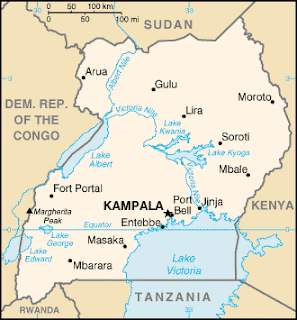
UgandaSeveral months ago, I had the opportunity to speak at a church about our ministry and vision for East Africa. After the service ended, I stayed in the foyer to greet and talk with members.

I’ll never forget what happened next.

A man came up to me and said, “Let me give you some advice. I’ve been going to church for many years and heard a lot of missionary presentations. You were far too negative in what you talked about. Who cares about cults? I want to hear something more positive, about the gospel being shared and Africans coming to know the Lord.”

Now, in all fairness, maybe I wasn’t as balanced as I could have been. And I certainly want to see the conversion of many Africans through the proclamation of the good news of Jesus Christ! Nevertheless, I think that his critique ultimately lacked biblical support. Jesus Himself warns us against those who seek to overthrow our faith in the Sermon on the Mount. So for the next couple of weeks, I want to briefly look at Christ’s words in Matthew 7:15–23.

In these verses, Jesus warns us that we must guard against spiritual deception. Why? As Jesus explains in verses 15–20, deceivers are dangerous:
Beware of false prophets, who come to you in sheep’s clothing but inwardly are ravenous wolves. You will recognize them by their fruits. Are grapes gathered from thornbushes, or figs from thistles? So, every healthy tree bears good fruit, but the diseased tree bears bad fruit. A healthy tree cannot bear bad fruit, nor can a diseased tree bear good fruit. Every tree that does not bear good fruit is cut down and thrown into the fire. Thus you will recognize them by their fruits.
Here we recognize a hidden danger. Jesus begins with the word “beware,” a command. This is not optional, not a suggestion, not a merely good idea. Our Savior requires us to beware of false prophets. And notice that He portrays these false prophets as an active concern, not a rare or occasional challenge. We’re to constantly be on guard against them because they’re always among us.

Wolf in Sheeps ClothingSo who are these false prophets? They claim to speak for God but entrap others through their lies. In the New Testament, we see that they are greedy, arrogant, immoral, and ungodly. But they also impersonate true Christians—they do their work in “sheep’s clothing.” False prophets seldom tell you that they reject the faith; instead, they’re ravenous wolves who actively seek to destroy Christians.

If this is true, how can we recognize them? Jesus provides us with an exposing test: Recognize them by their fruits. Most directly, these fruits are what Jesus has laid out throughout His sermon. Here we find two foundational kinds of fruit—(1) belief in Jesus, and (2) following Jesus’ teaching—in other words, belief and behavior. Both kinds of fruit need to be tested.

To underscore His point, Jesus states the obvious. Grapes can’t come from thornbushes, and figs can’t come from thistles. Plants only produce what is in their nature to produce. Only a healthy tree that bears good fruit; a diseased tree will produce bad fruit. And in this comparison we see that there’s no neutrality. All trees are bearing fruit; the question is, what kind? If you know the fruit, then you can tell the tree. Again, we see Jesus’ seriousness: All of the trees that do not bear good fruit are condemned (“thrown into the fire”). This is the same warning that John the Baptist gives earlier to the Pharisees in 3:7–10.

Finally, in verse 20 Christ repeats Himself: “you will recognize them by their fruits.” All Christians are commanded to be “fruit testers” by the very Lord of Glory.

Which leads me to ask: How seriously do we take spiritual deception? Do we recognize the danger? Are we prepared to test the fruit of those who claim to speak for God, either in what they teach or in how they live?

Let’s not forget that Christ’s command applies to His followers everywhere. How can you and I help our brothers and sisters in Christ around the world to recognize and resist deceivers? False prophets aren’t just a danger only here in America or the West; such people are seeking to overturn the revealed truth of Christ globally.

Next week, we’ll examine Jesus’ second reason for warning us against spiritual deception.

December 1, 2008

How We Honor Christ in Our Hearts

The most commonly quoted Bible verse on defending the Christian faith becomes even more powerful when we pause to study it in greater depth.

The Apostle Peter writes:
“But even if you should suffer for righteousness’ sake, you will be blessed. Have no fear of them, nor be troubled, but in your hearts honor Christ the Lord as holy, always being prepared to make a defense to anyone who asks you for a reason for the hope that is in you; yet do it with gentleness and respect, having a good conscience, so that, when you are slandered, those who revile your good behavior in Christ may be put to shame” (1 Peter 3:14–16).
First Peter notes our status in Christ, plainly stating something that few of us want to hear: We will suffer in Christ. As His followers, we must expect to suffer. Jesus explains that “If the world hates you, you know that it has hated Me before it hated you. If you were of the world, the world would love its own; but because you are not of the world, but I chose you out of the world, because of this the world hates you. Remember the word that I said to you, ‘A slave is not greater than his master.’ If they persecuted Me, they will also persecute you; if they kept My word, they will keep yours also” (John 15:18–20).

For believers, suffering isn’t optional; it’s inevitable for everyone who is faithful to Christ. But we should also be encouraged. Why? Because we will also be blessed. Even though we will face suffering, we ultimately have nothing to fear—not humiliation, not physical harm, not even death! When we’re united to Christ and receive His blessing, we have all that we need in Him!

Having established our status in Christ, Peter instructs us regarding our responsibility to the Lord. He first gives a negative requirement: Do not fear or be troubled. This command is drawn from Isaiah 8:11–13, which tells us that we’re not to fear man, but the Lord. Our security and hope rests in Him alone.

The ThinkerHaving set aside our fears and troubles, we must honor Christ as holy in our hearts. The heart is the core of our being, the origin of all our behavior, and the place where Christ must reign supreme. And notice how we’re to do this—by “always being prepared to make a defense” of our faith. The phrase “make a defense” is a translation of the Greek word apologia, from which we get the English word apologetics. Apologetics means simply a defense—in this case, a defense of the Christian faith. So God commands all followers of Christ to engage in apologetics, and we’re to do this with anyone who asks about our hope, with no favoritism or discrimination.

Peter takes us a step further, instructing us in the manner of apologetics. We’re to engage others gently and with reverence before God. How easy it can be to get caught up in winning an argument! In our zeal to prove Christianity true, we can appear rude and demeaning. But we’re not defending our faith for the sake of having intellectual battles; we’re doing it out of love for God and for others. We want nonbelievers to embrace God’s truth, and when we defend our faith kindly and reverently, we’ll keep a good conscience—and those who oppose us will be shamed.

Of course, these truths aren’t just applicable to Christians in the West; African believers are likewise commanded to make a defense before their challengers and opponents. And many of them face much harsher persecution! As obstacles and opposition to biblical faith multiply in Africa, we must stand with them and do all we can to equip them, that they might always be prepared to respond. And that’s the special focus and calling of the Africa Center for Apologetics Research.

Join with me in praying that God will raise up a mighty army of bold and humble apologists to bear witness to Christ throughout all of Africa, beginning in Uganda!

November 3, 2008

A Final Warning

Ephesus TheaterEphesus was the capital city of the Roman province of Asia and a place where the Apostle Paul spent much of his time as a missionary. He briefly visited this city at the end of his second missionary journey, but stayed for about three years during his third. By God’s grace, and through Paul’s faithfulness as well as that of other believers like Aquila and Priscilla, many people were saved. In fact, Paul’s ministry was so successful that “all the residents of Asia heard the word of the Lord, both Jews and Greeks” (Acts 19:10).

Paul dearly loved the church at Ephesus and eventually wrote a letter to them which is now included in our New Testament (Ephesians). Nevertheless, after staying with them for so long he had to return to Jerusalem. What would he say to the Ephesian church leaders in his final farewell? We find his words in Acts 20:18–35.

In this parting address, Paul includes a sober warning:
Pay careful attention to yourselves and to all the flock, in which the Holy Spirit has made you overseers, to care for the church of God, which he obtained with his own blood. I know that after my departure fierce wolves will come in among you, not sparing the flock; and from among your own selves will arise men speaking twisted things, to draw away the disciples after them. Therefore be alert, remembering that for three years I did not cease night or day to admonish everyone with tears (20:28–31).
Pay careful attention! Be alert! Why? Because “fierce wolves” and false teachers will attempt to divide and destroy the church of God, drawing Christians away by corrupting the gospel and God’s revealed truth.

Of the many instructions that Paul could have delivered in his last words to the Ephesian elders, he was compelled to prepare them for this singular challenge. They couldn’t be taken by surprise, or sit by in bewilderment, as destruction unfolded. They had to be constantly aware of the danger posed by cunning and merciless deceivers—and fully prepared to refute them with the truth of Christ and His gospel.

Little has changed since the days of the apostles. The calculated twisting of God’s Word is an ever-present challenge to His church—especially in Africa, where many pastors and church leaders have little if any biblical training. Too often, shepherds in East Africa cannot hear and apply Paul’s warning because they’re unable to practice biblical discernment, properly differentiating between scriptural truth and clever falsehoods.

Will you pray with me that Paul’s impassioned warning will ring loudly in the ears of church leaders across Africa? May we give them the tools and training they need to protect their flocks from the fierce wolves entering their midst!

July 14, 2008

Focusing on Prayer

PrayerWhenever people catch the vision for the Africa Center for Apologetics Research and ask what they can do to help our ministry in East Africa, I always begin with the same answer: Prayer.

But let's be honest, sometimes my response is simply seen as a required answer. Of course Christians are supposed to pray. What I find is that my answer regularly doesn't seem like it is enough for believers. They want to know what else they can do to help. Unfortunately, this way of thinking can minimize the importance of prayer. It seems as if some Christians see prayer as the bottom rung on a ladder of importance for ministry. It is obviously needed, but there are more important ways to be involved.

The Apostle Paul has the opposite understanding of prayer. Prayer lies at the very center of all our service to God. After he lays out the need for followers of Christ to put on the whole armor of God in Ephesians 6, he concludes that we must be "praying at all times in the Spirit, with all prayer and supplication. To that end keep alert with all perseverance, making supplication for all the saints" (v. 18).

Why is prayer for the saints so important? Because we are engaged in spiritual warfare. Earlier in this chapter, Paul explains, "For we do not wrestle against flesh and blood, but against the rulers, against the authorities, against the cosmic powers over this present darkness, against the spiritual forces of evil in the heavenly places. Therefore take up the whole armor of God, that you may be able to withstand in the evil day, and having done all, to stand firm (vv. 12-13). I know that there are a lot of crazy beliefs and practices out there regarding spiritual warfare today, but this does not change the biblical truth that we are in a very real spiritual battle.

Our enemies are not cultists. Our enemies are not false teachers. Our enemy is Satan and his demons. We fight against the spiritual forces of evil. And they are a fierce and powerful enemy.

The first time I visited Uganda, I was able to speak with a young African missionary working in northern Uganda. He is serving Christ in one of the most difficult areas in the region, with open political rebellion and violence. When he heard about our plans for developing a center to defend our faith, he quickly recognized the importance of our ministry. But then he looked at me and said, "You are about to enter one of the most difficult tasks I could ever imagine. The devil will be striving to stop you at every turn. He won't want to give up one inch of his territory, and you will have a long and difficult fight ahead."

I will never forget how serious he was. His eyes burned with fervency in light of our vision. It is almost as if he was making sure that I really knew what I was getting myself into. He caused me to pause and remember afresh the spiritual battle that I will be involved in through our ministry.

I don't take his warning lightly. But I also have hope, because Jesus Christ has triumphed over our enemy. In this spiritual war, He provides the power that I need to overcome. But this is accomplished through the faithful prayers of His people.

So when I say that the most important thing you can do for our ministry is to pray, I am not simply giving a required answer. I really believe that what ACFAR needs most is the faithful prayer of fellow Christians. Yes, we have additional ways that you can help, but I desire above all for many Christians to come together bringing our East African ministry before the throne of God.

Please pray for us! And if you haven't already, consider keeping up-to-date by joining our e-mail prayer list. Together, we will defend Christ and His gospel by His grace and for His glory.

April 7, 2008

A Global Need: Biblical Discernment

Our brief study on 1 John 4:1-6 has proven fruitful. This series began by recognizing the ever present danger of false teaching. We must all strive to avoid the many falsehoods that surround us in today's world. With this in mind, the Apostle John gives us two truths to remain faithful to our Savior. First, we must examine God’s messengers. Second, we must recognize opposing messages.

We cannot afford to make the mistake that the second-century theologian Tertullian made when he joined Montanism. We must practice biblical discernment!

As followers of Christ, we find ourselves involved in a raging war. Image yourself as a soldier in the front lines of battle. However, your enemies are not wearing military uniforms--they dress just like everybody else. You do not go out to fight at a distinct battleground, away from the civilian population. Your opposition could be anywhere. You have to go from house to house, not knowing if you'll find hostile enemies seeking to kill you or a regular family simply trying to stay out of harm's way. This is the difference between conventional warfare and guerrilla warfare. Whereas World War II was a conventional war, Vietnam was largely a guerrilla war. Obviously, fighting in these two kinds of wars is almost completely different.

What is my point? Practicing biblical discernment is like guerrilla warfare. False teachers do not easily distinguish themselves from your fellow brothers and sisters in Christ. They look, talk, and behave just like everybody else. They also do not attack from a distance. They seek to infiltrate from within. As a result, we cannot afford to simply trust anything that people who speak for God tell us. We must examine God’s messengers and recognize opposing messages. This may not be easy, but it is vital.

The Protestant Reformer John Calvin wrote about the need for a double test of doctrine:
[T]here is a double test of doctrine—private and public. The private test is that by which everyone settles his own faith, relying wholly on the doctrine that is known to come from God; for consciences will never find a safe and tranquil haven other than in God. The public test is the common consent and polity of the church; for as there is a danger of fanatics arising who may presume to boast that they are endued with God’s Spirit, it is necessary for the faithful to meet together and seek a way by which they may agree in a holy and godly manner. The old proverb is too true: ‘So many heads, so many opinions’; and it is doubtless God’s unique task to subdue our perverseness and make us think the same thing and agree in a holy unity of faith.
Both we as individuals and as corporate churches have an obligation to practice biblical discernment.

This obligation extends to mission work. Individuals and churches around the world need to practice biblical discernment. Remember, false teaching is not limited to our shores. Today Africa is a prime target for opportunistic preachers and serious error. Let us work together to build Christ's kingdom around the world by defending his truth and equipping His global body to remain faithful in a world of falsehoods.

March 31, 2008

Recognize Opposing Messages

How big of a threat are false teachers to Christianity? And what can we do about it anyway? As we have previously seen, being led astray from our faith through false teaching is a very real danger for all Christians. Thankfully, God has revealed to us how we can face this challenge. In 1 John 4:1-6, the Apostle John gives us two truths to remain faithful to our Savior. Last week, we looked at the first truth: we must examine God’s messengers.

Now we turn to the second truth. We must recognize opposing messages.

John continues his instructions in this passage by contrasting two spirits. "By this you know the Spirit of God: every spirit that confesses that Jesus Christ has come in the flesh is from God, and every spirit that does not confess Jesus is not from God. This is the spirit of the antichrist, which you heard was coming and now is in the world already" (vv. 2-3).

Illustrating the Apostles' CreedSo then, how do we know that a message of teaching comes from God? By conducting a doctrinal test. We turn to what God has already revealed in Scripture to test what someone’s saying. We always test a claim with the fundamental truths of Scripture. And these essentials have been summarized throughout Christian history in the creeds: the Apostles' Creed, the Nicene Creed, the Athanasian Creed, and the Chalcedonian Creed. All true teaching will agree with the Word of God and with these historic Christian creeds.

In this section of Scripture, John’s specific doctrinal test was the full humanity of Jesus Christ. Was Christ fully human? Did He have a physical body? The believers that John was writing to were struggling with the protognostics. They divided the human Jesus from the divine Christ. For the protognostics, the spirit of Christ filled the human Jesus at His baptism but left Him prior to His crucifixion and death. However, our struggle today is usually in the opposite direction. People don’t have a problem believing that Jesus was fully human. Their problem is believing that He is also fully God. Nevertheless, Scripture teaches us both: Jesus is fully human and fully God!

Since Jesus Christ is the center of our faith, it is normally with regard to His person and His work where you’ll hear falsehoods and error taught. Beware! Test what you hear.

These verses reveal two opposing spirits: the Spirit of God and the Spirit of Antichrist. Those who deny the fundamentals of our faith are not from God; they are in the spirit of the antichrist. Now I know that when we think of the antichrist, we think of a future person from the book of Revelation. But look at how antichrist is described here: “which you heard was coming and now is in the world already.” The focus is not on a person, but on a spirit that is very much here, now. In a sense, all of those who deny or corrupt the Christian faith are antichrists!

These are very strong words. Do you really believe them? Would you call the Jehovah’s Witnesses antichrists? They deny that Jesus is one with the Father. Would you call Oneness Pentecostals antichrists? They deny the Trinity, arguing that Jesus was not a distinct person from the Father but is simply a different mode of the Father. Our hesitation shows how comfortable we are in this world and how unimportant our beliefs actually are to us.

Regardless, the Apostle John's contrasts are not over. He moves from contrasting two spirits to contrasting two peoples: the people of God and the people of the world. "Little children, you are from God and have overcome them, for he who is in you is greater than he who is in the world. They are from the world; therefore they speak from the world, and the world listens to them" (vv. 4-5).

Let us never forget how we have become the people of God. God has created for Himself a people through Jesus Christ. We have been reconciled to our Father through the work of His Son. And like we saw last week, John again uses tender words when addressing believers as "little children." He lovingly encourages us and emphasizes that we have overcome. By being in Christ, we overcome the spirit of antichrist. But we overcome antichrists not by our strength or our wisdom, but because of the greatness and power of God. His Spirit, the Holy Spirit, is in us!

What about the people of the world? The spirit of antichrist comes from this fallen world, and false teachers use worldly wisdom and speech to fool others into believing falsehoods. But notice: it works! The world recognizes its own people and listens to their message, which reflects their own beliefs. Therefore, we should not be surprised when those in the world do not listen to God’s message. Apart from the Holy Spirit, those in the world are only too willing to continue believing lies.

What we find in this fallen world is the great antithesis. "We are from God. Whoever knows God listens to us; whoever is not from God does not listen to us. By this we know the Spirit of truth and the spirit of error" (v. 6).

There is a foundational divide between God's apostles and the world's prophets. These are two opposites with no middle ground! There is no neutrality in this world. There is either the spirit of God or the spirit of antichrist. You either follow the teaching of the apostles or the teaching of the world. In the Africa Bible Commentary, Kenyan theologian Samuel Ngewa writes, “John reminds the believers that there are only two spheres – the sphere of God and the sphere of the world. Anyone who claims to speak or act for God must draw his inspiration from one of these two spheres” (1534).

The sphere of God is found in the teaching of the apostles and prophets as recorded in Scripture. This is the spirit of truth. We are a people that believe in absolute truth, or as Francis Schaeffer called it, “true truth.” Nevertheless, the sphere of the world opposes true truth. False teachers come from this sphere. As a result, we are to differentiate between truth and error because God has revealed His truth to us in the Word of God.

With this in mind, are you living your life understanding that we as Christians are at war with the world? The world has its enemies, including some that attempt to infiltrate God’s people to do great harm and to overcome us. Thankfully, we are not left to ourselves to defend ourselves against them. By growing in our faith in Christ and trusting in His revelation, we have all that we need to overcome our enemies. We have His strength and His power.

At the same time, don't forget that the body of Christ is facing this threat globally. There are antichrists around the world today, including Africa. Let us not forget our international brothers and sisters in Christ as they face this daunting challenge, helping them to recognize the errors and falsehoods surrounding them. We all must recognize opposing messages.

Next Monday, we'll conclude examining this passage by thinking through what the Apostle John calls us to do.

March 24, 2008

Examine God’s Messengers

Last week, we identified a very real danger for all Christians--being led astray from our faith through false teaching. At the same time, God has revealed to us how we can face this challenge. In 1 John 4:1-6, the Apostle John gives us two truths to remain faithful to our Savior.

What is the first truth? We must examine God’s messengers. "Beloved, do not believe every spirit, but test the spirits to see whether they are from God, for many false prophets have gone out into the world" (v. 1).

The Apostle John begins with a term of endearment. He genuinely loves his fellow brothers and sisters in Christ. And it is this love that motivates him to warn them of the dangers to their faith. He writes to fellow believers from his heart.

Out of love, John starts by informing us of the risk. We all have a tendency to believe people who speak for God without critically analyzing what they are teaching. Why? We have all kinds of reasons. He is a very dynamic speaker. He speaks to me. He is a very moral, upstanding man. He loves the Lord. He is on the radio or TV. My friend loves him. He believes the same things I do. He always quotes from the Bible. To all of these, the Word of God replies: Do not believe every spirit.

John follows up this risk with a requirement, telling us what we must do. We are to test the spirits to see whether they are from God. Christianity is a faith that requires discernment. Followers of Christ need to believe God's truth and to reject all error. Unfortunately, I often think that the reason we don't practice discernment is because it is hard work. We'd rather veg out in front of the TV after a long day at work rather than study. We'll leave it to the theologians, pastors, and Sunday School teachers. We think, "I'll just take my simple faith and trust in Christ." But this attitude is simply not an option for believers.

Why not? John provides the reason. Many false prophets have gone out into the world. There are people who claim to speak for God or claim to teach his truth who are not actually from Him. They are false prophets and false teachers. And notice that they are not a rare or occasional problem for churches. They are a continual and constant danger. John does not just mention that there are false prophets. He says that there are many false prophets.

But this verse shows us one more thing. These false teachers have gone out into the world. We are dealing with a worldwide problem! No Christians are exempt. Yes, this includes Africa. We are not afforded the luxury of turning a blind eye to our brothers and sisters in Christ globally who are struggling with false teaching. All of us need to counter the errors that oppose our faith.

Wolves in Sheep's ClothingJesus Himself warned us all about this danger in Matthew 7:15-23. He begins by telling us, "Beware of false prophets, who come to you in sheep’s clothing but inwardly are ravenous wolves" (v. 15). False prophets and teachers are not usually easy to identify. They appear as one of us, sincere in their devotion to the Lord.

Which brings us back to where we began. We must examine God’s messengers. We are not free to skate by on a basic trust in Jesus. Trusting in Jesus calls us to know who He is, to understand what He has done, and to examine those who claim to speak about Him or for Him. Additionally, as God allows, we are to lovingly help fellow believers to know God's truth and to reject all error.

Is practicing this first truth easy? No. But if we are empowered by the Holy Spirit and armed with the Word of God, we can remain faithful to Christ. Next Monday, we'll identify the second truth given to us.

March 17, 2008

Remaining Faithful in a World of Falsehoods

Christianity has always struggled with people that have sought to draw Christians away from their faith by claiming to speak for God. In the mid-2nd century, Montanus came forward claiming to be the incarnation of the paraclete (usually translated as Helper or Advocate) spoken of by Christ in John 14:16. He said that he received direct revelations from the Holy Spirit. Essentially, God’s revelation continued through Montanus and would bring purity to the church.

Montanus quickly attracted many followers and was accompanied by two female prophets, Maximilla and Priscilla. They were called "the Three," having ecstatic visions and urging their followers to fast and pray with the hope of having their own personal revelations. Together, the Three warned against the growing worldliness of the church and called believers to return to Christ. While waiting for the Lord's return, the Montanists were to live a life of strict discipline and self-denial. This teaching spread all over the region, including Africa and Gaul.

Thankfully, within a few generations the Christian church declared Montanus’ teaching to be heresy. He had distorted the teaching of Scripture, ultimately overthrowing fundamental truths revealed by God. Nevertheless, his popularity shows how easy it is for Christians to be fooled into following false prophets and teachers.

TertullianBut before you think that the Montanists were limited to the ignorant and the poor people of this time, one of the most important and respected early church fathers eventually joined this group. Who was he? The North African theologian Tertullian. From developing the doctrine of the Trinity to writing Prescription Against the Heretics, he zealously sought to defend the Christian faith against doctrinal error. Nevertheless, Tertullian was attracted to the Montanists' rigorous pursuit of purity. He came to believe that the continuing sin of Christians proved that the church was an intermediate stage, giving way to the new age of the Spirit. As a result, Tertullian became the most famous member of this group.

What would lead one of the most brilliant Christian minds of his time to embrace such error? And how can we avoid all of the falsehoods that surround us in today's world? In 1 John 4:1-6, the Apostle John gives us two truths to remain faithful to our Savior:

Beloved, do not believe every spirit, but test the spirits to see whether they are from God, for many false prophets have gone out into the world. By this you know the Spirit of God: every spirit that confesses that Jesus Christ has come in the flesh is from God, and every spirit that does not confess Jesus is not from God. This is the spirit of the antichrist, which you heard was coming and now is in the world already. Little children, you are from God and have overcome them, for he who is in you is greater than he who is in the world. They are from the world; therefore they speak from the world, and the world listens to them. We are from God. Whoever knows God listens to us; whoever is not from God does not listen to us. By this we know the Spirit of truth and the spirit of error.
Next Monday, we'll identify the first truth.

March 10, 2008

Listening to James in Africa

"My brothers, if anyone among you wanders from the truth and someone brings him back, let him know that whoever brings back a sinner from his wandering will save his soul from death and will cover a multitude of sins" (James 5:19-20).
With these final words, James ends his letter. They are quite amazing when you stop to think about it. James has just finished writing to the church about their lives together in the midst of suffering and sickness. In essence, the body of Christ is bound together by prayer. If someone is suffering, pray. If someone is cheerful, praise God! And if someone is sick, have the church leaders pray. Can you see it? The church is a house of prayer.

But James does not end after writing about prayer. No, he has something else on his mind. Christians are also struggling with a serious challenge--false teaching. The church has been established on a foundation, the foundation of the apostles and prophets, Christ Jesus himself being the cornerstone (Ephesians 2:20). The church stands or false on the revelation entrusted to these men.

Yet there will always be those who seek to contradict or corrupt the apostles' teaching. And believers are constantly in danger of listening to them, wandering from God's truth. Therefore, James lets the church know that we are all required to refute error. By doing so, we accomplish nothing less than saving a soul from death and covering a multitude of sins. What a wonderful responsibility we have been given!

Unfortunately, this task is an unpopular one today. Pointing out false teaching is seen as mean-spirited, rude, and divisive. Additionally, missionaries that seek to defend God's truth are thought of as importing Western thinking, rejecting indigenization, and imperialism.

Nevertheless, these words from James are needed in Africa today more than ever. While we must always seek to contextualize the Word of God and not bog it down with cultural trappings, failing to follow James' instruction will lead to dire consequences. We simply cannot afford to look past our brothers and sisters in Christ as they are daily facing false teaching.

But you don't simply have to take the word of this American believer. Solomon Andria, an African theologian from Madagascar, wrote the following comments on these verses in the Africa Bible Commentary:
"The last paragraph of the letter confirms that James cannot be opposed to Paul.... He does not set works up against faith. Those who are lost are not those who have neglected works but those who have distanced themselves from the truth, that is, from the faith. Africa is fertile ground for new religions and sects, making it more important than ever to be well rooted in biblical truths through reading and studying the word of God. James' focus on truth at the end of his letter undermines any assertion that all he is interested in is works" (1516).