
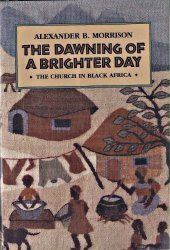
 Though Mormons have always zealously sought to convert others to their faith, in many ways their “last frontier” has been Africa. Given its long history of racism toward Africans, the LDS church’s early missionary efforts generally steered clear of black Africa. All of this changed when the LDS church released “Official Declaration—2” in 1978, allowing “worthy” Mormon males of African descent to hold the priesthood. Today the church reports amazing success over much of the continent, and with the recent announcement of the first black African general authority, Mormonism seems poised for even greater expansion—and confrontation with evangelical Christians.
Alexander B. Morrison, now an emeritus member of the First Quorum of the Seventy, recalls his church’s transformation from outsider to “contender” in Africa in The Dawning of a Brighter Day. Even though the book is now out of print, the fact that it was released by the official LDS publishing house testifies to its importance in understanding the changing face of Mormonism in Africa.
At the church’s October 1987 general conference, Morrison declared that “our humble African brothers and sisters are well prepared to receive and obey the fulness of the gospel of Christ”—that is, the message of Joseph Smith. Let us pray that the Body of Christ will prepare itself and resist.
From the inside cover:
“In some ways establishing the gospel in Africa represents the most difficult challenge the Church has ever had to face....We will succeed in Africa only as we learn and come to understand the oftentimes confusing social, political, historical, and economic realities of that vast continent and base what we do on real knowledge.”
So writes Alexander B. Morrison....In The Dawning of a Brighter Day, Elder Morrison describes some of the “confusing realities” of Black Africa, particularly as they pertain to proselyting efforts of the Church there.
“The golden key that unlocked the door to bringing the fullness of the gospel to Black Africa was the revelation on priesthood, received in June 1978,” he explains. Since then, missions and stakes have been established in several countries, and many faithful individuals have been converted and are ass uming leadership roles among the members.
Today, “the clouds if a long night’s darkness are beginning to roll away from Africa as a new day dawns,” Elder Morrison concludes. “It is a day whose light is the Son of God, a day made brighter by the glow of the glorious gospel of Christ.”

 One of the greatest obstacles to the missionary advance of the Mormon church in the 20th century was its notoriously racist view of Africans. Beginning with Brigham Young, generations of Mormon prophets and apostles characterized blacks as inferior and deformed (bearing the dreaded “mark of Cain”).



 The Movement for the Restoration of the Ten Commandments of God was a cult born in Uganda which ended in tragedy. The lives of roughly a thousand members, including many women and children, ended eight years ago in what is now known as the Kanungu Massacre. To understand how and why this Roman Catholic sect ended so violently, Ugandan scholar Bernard Atuhaire traveled to Kanungu to personally investigate the movement.
 The Kanungu Massacre has been permanently etched into the history and culture of Uganda since it tragically took place eight years ago. The Movement for the Restoration of the Ten Commandments of God was a breakaway cult from the Roman Catholic Church which ultimately ended the lives of hundreds of men, women, and children. Why did it happen? This obvious but difficult to answer question has been ringing in the minds of many people through the years. To come to a better understanding of this tragic movement, a number of scholars came together at Makerere University in Kampala, Uganda to present their research and analysis. Their resulting papers have been collected and combined into this essential resource.
 Though witchcraft is often mentioned in East Africa, it is more widely feared than subjected to critical study. Nevertheless, one recent book by Ugandans offers first-person research on witchcraft throughout the region. Wasswa is a Catholic priest and herbalist, while Miirima is a veteran local journalist. Together they have produced the only detailed examination of witchcraft currently available in Kampala’s general-interest bookstores. While I have not yet read it and thus cannot assess its level of scholarship,
 Finally, a book written by an African theologian exposing the errors of the prosperity gospel. With this false gospel running rampant throughout Africa, a biblical refutation has been desperately needed. Femi Adeleye has responded with this essential resource. While it may not be easy to find, I pray that this book will make its way into the hands of many African church leaders.
 It’s rare to find materials defending the Christian faith written and produced by Africans. This relatively little-known study booklet is an important exception. Serving as a guide for small groups or personal Bible study, False Teachers and False Teaching seeks to shine the light of Scripture on cults and error. The booklet begins with a very helpful introduction by Robby Muhumuza, who writes that “New churches and teachings are invading the towns and villages of Africa and taking them by storm.” Muhumuza describes the bitter fruit of cultic groups, noting the experience of “frustrated pastors in Kampala who...had some of their leading members go to sample some new teachings by a new controversial group in town. Some have not returned. Others have come back emotionally and spiritually wounded.”

 Posts

