Showing posts with label Book Reviews. Show all posts

May 27, 2009

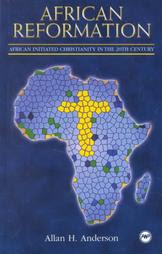
Book Review: African Reformation

Since African Apologetics has picked up a large number of new visitors and subscribers, we are re-running another one of John's important book reviews.

African ReformationAllan H. Anderson, African Reformation: African Initiated Christianity in the 20th Century (Trenton, NJ: Africa World Press, Inc., 2001), 282 pp.

The twentieth century witnessed the rapid expansion of Christianity throughout Africa. One of the main avenues of growth was in African Initiated Churches (AICs). These churches began in Africa and were started by Africans (not missionaries). What can we learn about their origins and development? How should we understand their place in global Christianity? Allan Anderson answers these questions in African Reformation. A white South African who is involved with AICs, Anderson combines his experience and knowledge with thorough research in this work.

The result is a book that is broken into three parts: context, history, and lessons. The author begins by seeking to characterize AICs and then moves to examining their causes. Next, he devotes a chapter to each region of Africa, summarizing the formation and progression of AICs through the twentieth century. Finally, Anderson concludes by providing an analysis of AICs in light of contemporary questions and issues.

I am amazed at how much information is packed into African Reformation. It is a veritable treasure trove of data on AICs. I will regularly consult this book as I conduct research on African Christianity. It will be an invaluable resource in understanding numerous churches and denominations in Africa.

At the same time, I found Anderson's third section lacking. As an "insider," he dismisses theological challenges far too easily and goes out of his way to minimize charges of syncretism. He essentially submerges Christianity into cultures, leaving us with numerous contextual theologies rather than with an overarching revealed Theology. As a result, he denigrates theology and philosophy while emphasizing experience and the dynamic, ever-changing nature of "spiritual" Christianity.

Anderson's treatment of salvation and the gospel is especially troubling. He writes:
"Salvation" in Africa needs to be related to more than an esoteric idea of the "salvation of the soul" and the life hereafter. It must be oriented to the whole of life's problems as experienced by people in their cities and villages. . . . Many AICs see "salvation" not exclusively in terms of salvation of sinful acts and from eternal condemnation in the life hereafter (the salvation of the soul), but also in terms of salvation from sickness (healing), from evil spirits (exorcism), and from other forms of misfortune" (233).
While Paul Hiebert and other missionaries today are correct in pointing out Western Christianity's unbiblical segregation of the natural and supernatural worlds leaving an excluded middle, expanding salvation itself into deliverance in this world easily corrupts the gospel. The fundamental problem in this world is our rebellion against God, not poverty, sickness, or evil spirits. Far from being esoteric, salvation from God's just wrath gives us true joy and hope. This does not mean that the gospel has nothing to do with the many challenges in our world, but they must be seen in light of our relationship to our Creator. We must distinguish between salvation in Christ and the many other ways that God works in this world.

In any case, there is a lot to like about Anderson's book. He has done all of us who are involved in African ministry a great service by providing so much material in one place. At the same time, his analysis must be read critically. For the discerning reader, African Reformation will prove tremendously useful.

May 20, 2009

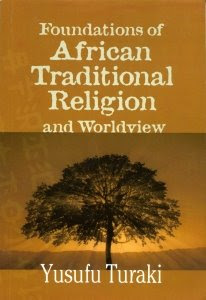
Book Review: Foundations of African Traditional Religion and Worldview

Since African Apologetics has picked up a large number of new visitors and subscribers, for the next couple of Wednesdays we will be re-running some of John's important book reviews.

Foundations of African Traditional Religion and Worldview
Yusufu Turaki, Foundations of African Traditional Religion and Worldview (Nairobi, Kenya: WordAlive Publishers, 2006), 128 pp.

There are many different ways that individuals can study African Traditional Religion (ATR): historical, psychological, sociological, etc. But one approach is often overlooked, the theological. When examined in this manner, many important questions are raised. What is the ATR worldview--its framework for understanding the world in which we live? What are ATR's basic beliefs? How does ATR compare to the Christian faith?

Yusufu Turaki seeks to answer these questions in his book Foundations of African Traditional Religion and Worldview. A Nigerian theologian and scholar, Turaki is certainly qualified to address these essential religious issues. He begins by defining religion and placing ATR within its religious context. Next he turns to explaining its fundamental theological, philosophical, and ethical beliefs. After laying this groundwork, the author continues to examine ATR's beliefs regarding the Supreme Being as well as the gods and spirits. Then he looks at how humans interact with the spirit world, from communication to the acquisition and use of power. Finally, he analyzes what it means to be human and the meaning of life according to ATR.

I learned a great deal from Turaki's book. To begin with, I appreciate his approach--laying out the fundamentals of ATR as a whole while showing how these foundational beliefs relate to each other. Understanding ATR as a worldview has been tremendously informative. I am amazed that he was able to include so much in such a few pages! This work will definitely be a convenient reference.

At the same time, I also find this book's brevity to be a limitation. When reading it, I regularly found myself wanting to dig deeper and learn more. At times, I almost felt as if I was reading through a beefed-up outline. While this may have been the author's intent, his book would be more useful with additional expansion and analysis.

Turaki also seems somewhat overly dependent on the work of Philip M. Steyne. He admits his dependence in the first chapter, but his citations and quotations from Steyne were so frequent that I occasionally wondered if I should simply read Steyne instead.

In any case, I'd still suggest that those interested in an introduction to ATR should read Turaki's book. It is a helpful starting point to further study. I hope that more theologians, philosophers, missionaries, and others will build off of the foundations of a work like this to further equip the body of Christ.

May 13, 2009

Book Review: Theological Pitfalls in Africa

Since African Apologetics has picked up a large number of new visitors and subscribers, for the next few Wednesdays we will be re-running some of John's important book reviews.

Theological Pitfalls in Africa
Byang H. Kato, Theological Pitfalls in Africa (Nairobi, Kenya: Evangel Publishing House, 1975), 200 pp.
At a small Anglican bookshop in Uganda, my eyes stopped when I came across a book on a crowded shelf. Immediately the title struck me--Theological Pitfalls in Africa. Intrigued, I picked up a copy and purchased it. I had never heard of Byang H. Kato (you can read an informative bio here), but I am always interested in learning more about theological controversies where I will be serving my Lord.
Needless to say, I made a wise investment. Kato responds to two dangerous trends he saw emerging in Africa: the growth of universalism and the danger of syncretism within contemporary African theology. Through the continuing influence of ecumenicism and liberal Christian scholarship, Kato writes about the increasing compromise and even abandonment of biblical Christianity throughout the continent.
In this book the author singles out for critique African theologians John Mbiti and Bolaji Idowu, as well as the ecumenical All Africa Conference of Churches (AACC). Through several chapters, he analyzes and replies to numerous problems that have been produced by these Christian leaders. His primary objective is to demonstrate the uniqueness and exclusivity of biblical Christianity against attempts to find parallels and continuity with African Traditional Religions. Additionally, as he records the progress of the ecumenical movement in Africa, he points to the need for an uncompromising evangelical alternative.
I greatly appreciate Kato's wisdom and doctrinal insightfulness throughout this work. He gave me much to think about. However, I do want to mention two cautionary notes. First, I am not sure that Kato is always properly summarizing the views of those whom he disagrees with. Having read some Mbiti, while a lot of Kato's critique is entirely appropriate, I also wonder if Mbiti is always properly understood. Occasionally, I wonder if Kato has set up a straw man only to quickly tear it back down.
Second, this book is rather dated. Of course, its age is not the author's fault! He actually prematurely died not long after this book was published (1975). Nevertheless, I can't help but wonder about the last 30-plus years. How prevalent is the ecumenical movement in Africa today? Where does African liberalism stand compared to the growth of evangelical scholarship? Are there more pressing theological challenges faced by Christians today? Answers to these questions must be found elsewhere.
In spite of these minor concerns, I still heartily recommend Kato's book for anyone looking to learn more about some theological dangers present in Africa today. While I am not sure how easy this book will be to buy outside of Africa, I assure you that it is worth the effort. May we be ever vigilant in our commitment to the Word of God, refuting all attempts to overthrow God's revealed truth!

April 29, 2009

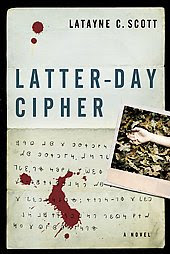
Book Review: Latter-day Cipher

Latayne C. Scott, Latter-day Cipher. Chicago: Moody Publishers, 2009.

Latter-day CipherWhat happens when you take a fictional suspense-thriller and place it in Utah, the center of Mormonism? Latayne C. Scott gives us an example in her novel Latter-day Cipher. A former Mormon who converted to evangelical Christianity, Scott helps readers understand Mormonism through a murder mystery.

The main character is Selonnah Zee, who winds up in Utah when the murders begin taking place. As a journalist, she is quickly assigned to cover the growing number of deaths which are connected by Mormonism and its history. In reporting on these complex cases, she finds herself embarking on a crash course in Mormonism, from her LDS cousin Roger to her newfound local reporter friend Anne. Can Selonnah wrap her mind around Mormonism enough to solve these crimes? And what will these crimes expose about the Mormon church? You’ll have to read the book to find out.

I admit up front that I don’t read a lot of fiction, so I’m not evaluating the book’s literary merits from a position of strength. I can see reviewers critiquing Scott’s work as being somewhat underdeveloped, with the plot serving primarily as a vehicle for teaching readers about Mormonism. With this in mind, the book may fall short for someone who’s simply looking for a good thriller.

At the same time, I really appreciate Scott in her attempt to creatively educate people about Mormonism. Many Christians and others may never pick up a book summarizing and evaluating LDS teaching. But they would likely be drawn to a contemporary murder mystery novel which is filled with information on Mormonism’s history and beliefs. Consequently, as a teaching tool, I really like her book. I would definitely give it to a Christian friend who enjoys this kind of fictional work. It even has questions for discussion in the back to think through some of the concerns and issues that she raises.

Nevertheless, I should offer a few disclaimers. First, given the nature of the crimes, the storytelling can be graphic and may be inappropriate for some readers. Second, Selonnah’s friend Anne is a Christian who explains the Trinity by using the analogy of three states of water (ice, water, and steam)—a common illustration that’s fundamentally flawed and can lead to a misunderstanding of the nature of God. Third, I don’t think the ending provides sufficient closure to the story. I can only assume that this book is meant to be the first of a series, but I felt like the book just kind of abruptly ended.

In any case, I don’t believe that these caveats should necessarily prevent Christians from reading an entertaining page-turner which will also inform them a great deal about Mormonism. I pray that the Lord will use Latter-day Cipher to better prepare His people to lovingly respond to the errors of Mormonism with the truth of biblical Christianity.

February 18, 2009

Book Review: Who are the Living-Dead?

Richard Gehman, Who are the Living-Dead? A Theology of Death, Life After Death and the Living-Dead. Nairobi: Evangel Publishing House, 1999.

Who are the Living-Dead?While preparing to become a missionary in East Africa, I am seeking to better understand the cultural beliefs and worldviews of those living in this region of the world. The latest book I have completed is Who are the Living-Dead? A Theology of Death, Life After Death and the Living-Dead by Richard Gehman. Gehman is an American missionary who served for years with the Africa Inland Mission at Scott Theological College in Kenya. He is also editor of the Africa Journal of Evangelical Theology.

The living-dead may not be much of an issue for Christians and others in North America, but they are very real for many Africans. As an experienced missionary teaching African pastors, Gehman recognized the need to address ancestors, death, and the living-dead biblically. He summarizes his purpose with three goals:

This book has three objectives:
(1) to provide theological and pastoral help for the Christian pastors and church leaders in Africa so that they can teach and strengthen Christians to face sickness and death with courage without returning to African Traditional Religion.
(2) to provide the educated, thinking lay Christian in Africa with an understanding of death according to the Bible so that he can develop a Christian world view and stand strong in his faith.
(3) to help the church in Africa develop a biblical theology of death, life after death and the living-dead so that she will continue to grow strong in the knowledge of the gospel and resist teaching contrary to the truth of the gospel (x).

His book is broken down into five parts. The author begins by explaining and summarizing the African Traditional Religion's beliefs and practices regarding death, life after death and the living-dead. Then he examines how Christians are to relate to God and to our parents, including the tension between the first and the fifth commandments concerning worship and honor. Next, he turns to different solutions Christians have offered to these issues in Africa, assessing their truthfulness in light of Scripture. The rest of his work is devoted to building a biblical understanding of the living-dead, death, and the afterlife.

Overall, Gehman's book is excellent. I found it very informative. He tackles many questions, such as the difference between veneration and worship, whether the living can speak and relate to the dead, and the powers of darkness. His work is theologically rich while remaining clear for the average believer. Additionally, I am grateful to his continual commitment to the centrality of Scripture in his study. He exegetes numerous biblical texts to see how they relate to the important issues under consideration.

One section of this work that really stands out is his consideration of the intermediate state (as well as his appendix on Hades and Sheol). What happens to believers and unbelievers between their deaths and the time when Christ returns? Gehman's treatment is one of the best overviews surrounding this complex question that I have read. Easy to understand and biblically compelling, I am especially thankful for the clarity he brings to this difficult issue.

However, I do have a couple of disagreements. First, Gehman seems to believe that Christians can be demonized (demon possessed). He writes:

Christians who are walking in obedience to God, filled by His Spirit and washed in the blood, have nothing to fear from the powers of darkness, as we shall see. But the Christian who lowers his guard and falls away from God by living in sin, may open himself up to various forms of oppression from the unclean spirits. There are various degrees of demonic control, ranging from milder forms of demonic oppression to a complete spirit possession (170).
While demons are real and can bring severe external oppression upon Christians, a true follower of Christ cannot be demonized. For more information and an excellent refutation of this view, see the article "Can a Christian Be 'Demonized'?" by Brent Grimsley and Elliot Miller in the Summer 2003 issue of the Christian Research Journal.

Second, when dealing with the destiny of the unevangelized, Gehman leaves open the possibility of salvation apart from the gospel. Following Reformers such as Zwingli and others, he says:

General revelation does not offer any hope of salvation. Only by a special revelation from God Himself can anyone understand his own sinful condition, repent of his sin, and turn to the Lord for forgiveness. Normally this comes through preaching the gospel. But there may be some individuals whom God draws to Himself apart from such proclamation, as He did with Job, Melchizedek and others. But this is the exception, not the rule (282).

In his analysis, the author simply does not sufficiently take into account the progression of redemption. We do not live in the era of Job and Melchizedek. Jesus Christ has come, establishing the reality of the new covenant. No hope exists apart from gospel proclamation.

Nevertheless, I cannot stress enough the importance of this book for Africans and missionaries serving our Lord in Africa. The church is indebted to Gehman for his taking the time to provide a theology of death, life after death, and the living-dead. I am sure that this book will continue to be essential reading for years to come.

One last note: this book was published by Evangel Publishing House in Nairobi, Kenya. While their distribution reaches Britain, this book may not be easy to find and purchase. Do not let this challenge deter you—it is well worth the money.

January 14, 2009

Book Review: Free Indeed From Sorcery Bondage

Marvin S. Wolford, Free Indeed from Sorcery Bondage. San Rafael, CA: Pathway Press, 1999.

Free Indeed From Sorcery Bondage
"Now the works of the flesh are evident: sexual immorality, impurity, sensuality, idolatry, sorcery, enmity, strife, jealousy, fits of anger, rivalries, dissensions, divisions, envy, drunkenness, orgies, and things like these. I warn you, as I warned you before, that those who do such things will not inherit the kingdom of God" (Galatians 5:19-21). The Apostle Paul warns followers of Christ about the works of the flesh. In the West, we are familiar with most of these sins. But sorcery? What should we think of this evil?
For people living throughout Africa, this is not an abstract question. Sorcery is a part of their daily lives, and it does not simply disappear when one becomes a Christian. Marvin S. Wolford should know--he served as a missionary for 42 years in the Republic of Congo. And he brings the light of Scripture to bear on his experience and ministry in Free Indeed from Sorcery Bondage.
His book is divided into three parts. To begin, Wolford explains the reality of sorcery in Africa. For many throughout the continent, sorcery is more than a reality. It is a way of life. Next, the author turns to the Word of God. What does the Bible have to say about sorcery? Quite a bit, actually. But too many of us have never really taken the time to recognize the numerous passages dealing with sorcery or connected beliefs and practices. Wolford leaves no stone unturned, thoroughly explaining what God's truth has to say about this overlooked issue. Finally, he seeks to bring his insights down to a practical level. How can believers minister to sorcery-bound people? Practical steps and guidance is given to those seeking to work with individuals involved in sorcery.
I really appreciate Wolford's work. His explanation of sorcery in animistic contexts was enlightening. He also includes numerous examples of people throughout Africa, showing how central the sorcery cycle is to different cultures and people groups. Most importantly, he turns to Scripture for a true assessment of sorcery. This is the book's key strength. One may consult various anthropological or sociological materials to learn about sorcery. But only the Bible provides the examination necessary for faithful and fruitful ministry among those who live with sorcery. I enthusiastically agree with the author when he observes:
Preaching based on the scriptural facts, plus teaching the meaning and pertinence of the Scriptures, are the means of delivering people bound by sorcery. There is no human strength nor human wisdom that can deal with the situation. Spirit filled evangelistic preaching from the Bible, which regards sorcery as a sin, but a forgiveable sin, should direct people to a definite time of confession and repentance that will make a definite break with their past beliefs and practices. This is precisely the first work of the Holy Spirit in those who are in bondage (81).
At the same time, I must admit that Wolford and I come from different perspectives. He is a Wesleyan Arminian. Hence, in his rejection of fatalism, I have difficulties with his defense of personal free choices. He says, "Consequently, it is God's will for everyone to choose life; but the choice is up to each person" (134). Or, "When Jesus urges: 'Seek first his kingdom and his righteousness,' he is admonishing his hearers to make the choice to seek God's kingdom first before all other things, but he leaves that decision up to them" (137). Biblically, we simply do not have this kind of freedom. Our hearts, our minds, our wills, every part of us is depraved. We would never choose God if left to ourselves. It is only through God's sovereign work of grace that we repent, believe, and obey Him.
Additionally, I would disagree with his belief in a second work of grace. Wolford writes "there is a distinct experience of filling that is separate from the initial salvation which Christ accomplishes in the repentant sinner's heart. The Holy Spirit is sent by Christ himself (see John 15:26), and his work in the believer is to glorify Christ (see v. 14), to guide him into all truth, and to give power to his life" (179). Thus, he divides Christians into two groups: victorious Christians and nominal Christians. However, this is an artificial separation. All believers are filled with the Holy Spirit when we are saved. Our lives are a slow process of spiritual maturity as we become more like Christ.
Regardless, I would not let these differences stop a Christian from being richly blessed through the reading of Free Indeed From Sorcery Bondage. Wolford provides such a wealth of insight and biblical application that I believe all missionaries serving where sorcery is a challenge should read this book. As I prepare to serve my Savior in Africa, I am sure that I will be regularly referring back to Wolford's work.
Unfortunately, his book is no longer in print. However, you can still purchase copies through sending a check for $10 each plus $2 shipping per book to:
Jean Wolford
125 Lowry Lane
Wilmore, KY 40390
For those desiring to learn more about this vital subject, make sure to pick up a copy while you can.

December 17, 2008

Book Review: Cultic Doctrine of Seventh-day Adventists

Dale Ratzlaff, Cultic Doctrine of Seventh-day Adventists. Glendale, AZ: Life Assurance Ministries Publications, 2003; 383 pp.

Cultic Doctrine of Seventh-day AdventistsSeventh-day Adventism has had amazing success around the world, especially in Africa. (There are some 1.5 million Adventists in East Africa alone.) Since my exposure to Adventism has been limited, due diligence demands that I become well acquainted with the movement’s history and beliefs. In this important book Dale Ratzlaff introduces evangelical Christians to the troubling doctrines of historic Adventism—and confronts Adventists with the seriousness of their error. As a fourth-generation Adventist and former SDA pastor, Ratzlaff has the insight and experience necessary to critically evaluate Adventist doctrine and the personal authority required to call Adventists to repentance.

He begins by taking us back to the Millerite movement, with its failed predictions of Christ’s Second Coming in 1843 and 1844. When the latter date came and went without Jesus’ return, a vision by one disappointed Millerite led many to believe that the prediction had been misunderstood; instead of Christ’s reappearance, it marked when He invisibly entered the Most Holy Place of the heavenly sanctuary for the first time, beginning a new phase in his atoning work. Ellen G. White was among those who embraced the new doctrine, and she quickly developed a following as one who had the end-time “spirit of prophecy.” Through her leadership and authority, the Church grew in size and influence, and further defined its distinctive beliefs of the cleansing of the heavenly sanctuary and the “investigative judgment.”

Having carefully placed these and other central SDA beliefs in their historical context, Ratzlaff provides biblical, theological, experiential, and ethical evaluations. From examining Adventist interpretations of Daniel 8:14 and Revelation 14:6–12 to showing how these errant beliefs weave themselves throughout the SDA doctrinal system, Ratzlaff leaves no stone unturned. He concludes by contrasting the cleansing of the heavenly sanctuary and the investigative judgment with the gospel of Jesus Christ, and he appeals to SDA leaders to follow God’s truth instead of their traditional beliefs.

The book is amazingly informative. I began Cultic Doctrine with little familiarity with Seventh-day Adventist teachings and ended with a substantial understanding of what makes Adventism “tick.” What’s more, Ratzlaff’s reasoning is well laid out and convincing, documented with numerous extended quotations from Ellen G. White and other major Adventist authorities.

I especially appreciate Ratzlaff’s evenhanded approach to the Seventh-day Adventists themselves. He distinguishes among different streams of Adventism, including contemporary historic Adventism, liberal Adventism, and evangelical Adventism. He admits that evangelical Adventists should, as individuals, not be shunned as cultic, but emphasizes that denominational Adventism fully deserves the label until it repudiates its teachings on the heavenly sanctuary and the investigative judgment—false doctrines that corrupt the gospel of Jesus Christ and demand biblical refutation.

Cultic Doctrine does have the usual problems one sees in independently published works, including typos and formatting issues. It also could have been more concise through robust editing. Nevertheless, these minor points should not detract from the importance of Ratzlaff’s book. Any Christian who wants to better understand Seventh-day Adventists and engage them with the gospel of Christ should read Cultic Doctrine. And Adventists themselves should wrestle through the issues that Ratzlaff raises. May our Lord continue to use this work and Life Assurance Ministries to draw people to Jesus!

November 19, 2008

Book Review: Five Views on Apologetics

Five Views on ApologeticsSteven B. Cowan, ed., Five Views on Apologetics (Grand Rapids, MI: Zondervan Publishing House, 2000), 398 pp.

The Apostle Peter exhorts Christians to “Always be prepared to give an answer to everyone who asks you to give the reason for the hope that you have” (1 Peter 3:15). Believers recognize that God calls us to the defense of our faith—that is, to the practice of apologetics. But how do we defend our faith? How do we give an answer? Throughout church history, Christians have approached the task of apologetics in a variety of ways. Steven Cowan has brought together proponents of five different views to defend their apologetic method and interact with the other contributors. The result is Five Views on Apologetics.

Five scholars participated in this printed discussion advocating their views: William Lane Craig, the classical method; Gary Habermas, the evidential method; Paul Feinberg, the cumulative-case method; John Frame, the presuppositional method; and Kelly James Clark, the Reformed epistemological method. This book follows the typical format established by previous titles in Zondervan’s Counterpoints series. Each contributor begins a section by summarizing and defending his method, followed by a response to the initial presentation by each of the other authors. After the last view is presented and engaged, the original advocates have a final opportunity to reply to the other contributors. By the time the reader finishes the book, he or she should have a much better understanding of each individual approach and the differences among the methods.

I really enjoyed this book. Apologetic method has always interested me, and bringing together several of today’s leading evangelical apologists to interact with one another on how we should defend our faith was sure to bring forth fruitful discussion and insight. While I won’t focus on which methodology I prefer (even though some of you may already know!), I can say that I richly benefited from each presentation and the back-and-forth of the contributors.

Still, I do wonder if the editor could have chosen better advocates for the viewpoints presented. Almost none of the contributors could be accurately described as a “purist.” As Frame points out in one of his responses: “In my view, not a great deal of difference exists between the methods of William Craig, Gary Habermas, and Paul Feinberg” (132). Kelly James Clark begins his response to Craig by saying, “I could have written William Craig’s essay (at least major parts of it)” (82). Such statements occur frequently, with those involved voicing their general agreement with one another. William Lane Craig even comments: “What we are seeing in the present volume is a remarkable convergence of views, which is cause for rejoicing” (317). Maybe so, but in a book seeking to introduce readers to the peculiarities and differences among various apologetic methods such a “convergence” only muddies the waters. Perhaps including an “eclectic method” or “integrationist method” as a separate attempt to bring together the other views into a new approach alongside more traditional presentations would have been more beneficial.

The work also seems overly technical. Multiple-view books function best as introductions to the central issues of contemporary debates. Having to wade through difficult philosophical concepts and the probability calculus of Bayes’ Theorem is far beyond the capability of most lay Christians. Restricting the discussion of apologetic method to such a high academic level severely limits the book’s usefulness. And this is a shame, since such scholars could greatly help our brothers and sisters in Christ to think more clearly about how to defend our faith.

Consequently, I finished this book with mixed thoughts. On the one hand, it’s an informative work on an important topic for contemporary Christians; on the other, I can’t see recommending it often to fellow believers. Nonetheless, I’m sure it will give helpful insights to those who are somewhat acquainted with philosophical and theological issues related to apologetics, as well as to others who are willing to slowly and carefully work through its contents.

October 15, 2008

Book Review: A Gentle Wind of God

A Gentle Wind of GodRichard K. MacMaster and Donald R. Jacobs, A Gentle Wind of God: The Influence of the East Africa Revival (Scottdale, PA: Herald Press, 2006), 403 pp.

As I prepare to serve Christ in Uganda, I am continually seeking to better understand Christianity in East Africa. Upon the advice of Dr. Solomon Nkesiga from Kampala Evangelical School of Theology (KEST), I have been focusing my research lately on the Balokole and the East Africa Revival. One of the few books readily available in America on this topic, A Gentle Wind of God serves as an introduction to this largely unknown but central movement in Africa and its growing influence in the Western world.

The authors begin their account as the revival begins in Rwanda and then Uganda in the early 1930s. It started with a few men who desired renewal in the Anglican churches in East Africa. They had been deeply impacted by the cross of Christ and desired to live repentant lives in union with their Savior. Their devotion quickly spread throughout the region, causing many to meet together regularly as they grew deeper in their relationships to Christ. Through much opposition and struggles, these Balokole ("the saved ones") continued to expand and meet together, impacting many churches and denominations with their Christ-centered faith.

At the same time, the revival not only took hold among Africans--many Western missionaries were deeply affected as well. They took the East Africa Revival home through correspondence, return visits, and ministry opportunities. This was especially true of many Mennonite missionaries serving in Tanzania and elsewhere. As a result, this book devotes a great deal of space to the influence of the revival in the West. What was the message of the East Africa Revival?
If one were to try to summarize the message of so-called revival, it would be something like this. Come to Jesus with your sins; repent and be cleansed by the blood of Jesus Christ; live in the immediacy of the presence of Jesus, and walk in open fellowship with the brothers and sisters; absorb yourself in the Word of God by life-changing Bible study; allow Jesus Christ to do good deeds through you by the enabling of the Holy Spirit; and witness with word, life, and action that Jesus Christ is the head of the individual and of the body of believers (21).
When reading this book, I couldn't help but be moved by recognizing God's hand at work in East Africa. I have found many new heroes of the faith, including Ugandans such as William Nagenda and Festo Kivengere. I stand in awe of the Holy Spirit, who drew many thousands of people to Christ through this movement. The authors are to be commended for bringing together such a powerful testimony to God's glorious kingdom.

At the same time, I thought the book was somewhat imbalanced. A disproportionate amount was devoted to the transformation of the American Mennonites. It seemed as if the actual revival in East Africa was somewhat glossed over while great detail was included for such Mennonites as the Leathermans and the Mausts. Maybe this was due to the authors being Mennonites and the publishing house being a Mennonite press. Nevertheless, I wanted to read more about what was happening in Africa. Additional balance would have been appreciated.

Nevertheless, I still recommend MacMaster and Jacob's work. America and the West are not the only places where God has blessed His church. Hopefully, many more Christians will come to know and cherish the East Africa Revival.

August 20, 2008

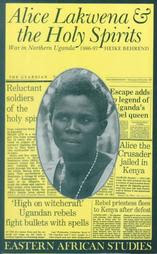
Book Review: Alice Lakwena and the Holy Spirits

Alice Lakwena and the Holy SpiritsHeike Behrend, Alice Lakwena and the Holy Spirits: War in Northern Uganda, 1986-1997 (Athens, OH: Ohio University Press, 1999), 210 pp.

When most people think of cults in Uganda, three groups come to mind: Joseph Kony's Lord's Resistance Army, Joseph Kibweteere and Credonia Mwerinde's Movement for the Restoration of the Ten Commandments of God, and Alice Lakwena's Holy Spirit Movement. This book seeks to chronicle the formation, growing success, and ultimate failure of Lakwena's movement. As an anthropologist, Heike Behrend seeks not only to describe this cult, but also to set it in its historical and social context.

The author begins by struggling through the issues of writing an anthropological study on Alice Lakwena and the Holy Spirit Movement. Then she recounts the history and development of the ethnic identity of the Acholi people from Northern Uganda. Next, she writes about Alice Auma as she becomes the medium for the (male) spirit Lakwena and begins to form a military mobile force to purify the land from evil in the midst of political and military turmoil. This history continues to unfold from the humble beginnings in Paraa and Opit to the several thousand member army marching toward Uganda's capital. Finally, the downfall and final defeat of the Holy Spirit Mobile Forces is summarized. The remainder of the book is given over to further analysis of what happened, as well as briefly looking at developments since the fall of the Holy Spirit Movement.

As one who is in the process of becoming a missionary in Uganda, I found this book to be exceptionally informative. I've learned a lot about the history of Northern Uganda generally and of the notorious Lakwena's Holy Spirit Movement specifically. And by reading about the context in which these events took place, I was able to better understand the traditional beliefs and practices of East Africans as well as the syncretism that forms from combining these traditions with elements of Christianity.

At the same time, this work is an academic tome and can be hard to read. The author assumes a certain amount of previous knowledge of anthropological and sociological concepts and issues. She also regularly points to and interacts with various scholarly theories. Thus, this book is not an accessible treatment of the history of Lakwena and the Holy Spirit Movement.

As a result, one may or may not find reading this book to be beneficial. Anthropologists, missionaries, and others looking to learn more about this important sect in Ugandan history will surely want to read Behrend's study. But more casual readers will likely find themselves lost in the scholarly discussions and analysis. For those willing to dive in and develop their understanding of these key events, I recommend consulting this work.

July 23, 2008

Book Review: African Reformation

African ReformationAllan H. Anderson, African Reformation: African Initiated Christianity in the 20th Century (Trenton, NJ: Africa World Press, Inc., 2001), 282 pp.

The twentieth century witnessed the rapid expansion of Christianity throughout Africa. One of the main avenues of growth was in African Initiated Churches (AICs). These churches began in Africa and were started by Africans (not missionaries). What can we learn about their origins and development? How should we understand their place in global Christianity? Allan Anderson answers these questions in African Reformation. A white South African who is involved with AICs, Anderson combines his experience and knowledge with thorough research in this work.

The result is a book that is broken into three parts: context, history, and lessons. The author begins by seeking to characterize AICs and then moves to examining their causes. Next, he devotes a chapter to each region of Africa, summarizing the formation and progression of AICs through the twentieth century. Finally, Anderson concludes by providing an analysis of AICs in light of contemporary questions and issues.

I am amazed at how much information is packed into African Reformation. It is a veritable treasure trove of data on AICs. I will regularly consult this book as I conduct research on African Christianity. It will be an invaluable resource in understanding numerous churches and denominations in Africa.

At the same time, I found Anderson's third section lacking. As an "insider," he dismisses theological challenges far too easily and goes out of his way to minimize charges of syncretism. He essentially submerges Christianity into cultures, leaving us with numerous contextual theologies rather than with an overarching revealed Theology. As a result, he denigrates theology and philosophy while emphasizing experience and the dynamic, ever-changing nature of "spiritual" Christianity.

Anderson's treatment of salvation and the gospel is especially troubling. He writes:
"Salvation" in Africa needs to be related to more than an esoteric idea of the "salvation of the soul" and the life hereafter. It must be oriented to the whole of life's problems as experienced by people in their cities and villages. . . . Many AICs see "salvation" not exclusively in terms of salvation of sinful acts and from eternal condemnation in the life hereafter (the salvation of the soul), but also in terms of salvation from sickness (healing), from evil spirits (exorcism), and from other forms of misfortune" (233).
While Paul Hiebert and other missionaries today are correct in pointing out Western Christianity's unbiblical segregation of the natural and supernatural worlds leaving an excluded middle, expanding salvation itself into deliverance in this world easily corrupts the gospel. The fundamental problem in this world is our rebellion against God, not poverty, sickness, or evil spirits. Far from being esoteric, salvation from God's just wrath gives us true joy and hope. This does not mean that the gospel has nothing to do with the many challenges in our world, but they must be seen in light of our relationship to our Creator. We must distinguish between salvation in Christ and the many other ways that God works in this world.

In any case, there is a lot to like about Anderson's book. He has done all of us who are involved in African ministry a great service by providing so much material in one place. At the same time, his analysis must be read critically. For the discerning reader, African Reformation will prove tremendously useful.

June 18, 2008

Book Review: Claiming Christ: A Mormon-Evangelical Debate

Claiming ChristRobert L. Millet and Gerald R. McDermott, Claiming Christ: A Mormon-Evangelical Debate (Grand Rapids: Brazos Press, 2007), 238 pp.

The Apostle Paul warns us against “he that cometh [and] preacheth another Jesus, whom we have not preached,” or offers “another spirit, which ye have not received, or another gospel, which ye have not accepted” (2 Corinthians 11:4). Devious preachers may proclaim another Jesus, another spirit, or another gospel. With this in mind, how does one know which Jesus is the true Jesus? Do Mormons preach the true Jesus? Do evangelicals? Do Mormons and evangelicals believe in the same Jesus? These are the kinds of questions that Mormon scholar Robert Millet and evangelical scholar Gerald McDermott debate in Claiming Christ.

After providing background on their personal friendship, McDermott and Millet take turns interacting on various topics related to Christ. Starting with their sources of authority, the co-authors move on to a discussion of Christ before Bethlehem, the Trinity, Jesus’ passion and atonement, the historical Jesus, the church and the sacraments, salvation in Christ, and the fate of the unevangelized. In each chapter, one writes the main article, the other follows with a response, and a final rebuttal concludes the section. This format allows the reader to grapple with both authors’ views.

Unfortunately, McDermott’s role as an evangelical contributor is compromised by his deficient view of the Bible. He denies biblical inerrancy, questions the sufficiency of Scripture, and rules out the principle of Sola Scriptura (i.e., that the Bible alone is our final authority in faith and practice). Thus, he says “‘The real question, then, is not whether we will be influenced by tradition in our reading and interpreting, but which tradition?’” (20). Unfortunately, McDermott misses the point. Sola Scriptura does not mean that we can interpret Scripture apart from tradition; it means that the Bible is the Christian’s ultimate standard of truth. We can (and must!) subject our traditions to what God has revealed in Scripture. The Word of God is the ultimate arbiter of truth.

Since McDermott denies these fundamental beliefs, he comes across as more interested in maintaining historic orthodoxy rather than in biblical faithfulness. A typical example would be his treatment of the gospel and the relationship between faith and works. Rather than expositing relevant biblical passages, McDermott gives the reader a comparative analysis of the views of Martin Luther and Jonathan Edwards. In the following chapter on the destiny of the unevangelized, McDermott does not try to answer this difficult issue with Scripture; instead, he summarizes the positions of Justin Martyr and Irenaeus, showing that Christians throughout history have been somewhat flexible. Often I was left asking: So what? How is one to know whether these Christians were right or wrong in their views? The Mormons, as it turns out, have an answer: An authoritative prophet tells us. McDermott never effectively counters the Mormon claim with the proper response—namely, that we have authoritative Scripture to enable us to discern truth from error. Orthodoxy is the result of biblical faithfulness. And while church history can assist us in understanding our faith, it must never be the basis upon which we establish our faith.

McDermott often fumbles when trying to point out similarities between Mormonism and historic Christianity. For example, he consistently maintains that Mormons believe Jesus is fully divine. He actually states: “Rejecting the Nicene definition of the Trinity but holding to the full deity of Jesus and salvific value of his cross and resurrection seems not as serious as denying the incarnation and the atonement” (221). But as I have written to him before:

. . . I do not know how you can maintain: “On the LDS and Jesus, it is a fact that the Mormon view of Jesus is better than the Jehovah’s Witness view, which is fully Arian. They do indeed believe Jesus is fully God.” While I have no problem insisting upon the defectiveness of the JW Jesus, the LDS Jesus is no less defective. The LDS do not believe that Jesus is fully God—if we are defining God consistently. The only way one could maintain that the Mormons believe that Jesus is fully God is by committing the fallacy of equivocation, for the God we refer to is nothing like the God of Mormon doctrine. The word "God" is not some nebulous, abstract notion. God has revealed what divinity is to us.

Essentially, the LDS church redefines "God" when applying the term to Jesus. And in his case, it is no different from the Jehovah’s Witnesses, because both refuse to ccept Jesus as the eternal, immutable, omnipotent, omniscient God. Both offer distortions f the one, true Trinitarian God. As you have stated, the LDS Jesus is not the Jesus of lassic orthodoxy. He is a false Jesus—an imaginary Jesus who cannot save.
McDermott’s equivocations throughout this work all too often prevent one from properly understanding the distinct and opposite beliefs which separate Mormonism and evangelical Christianity.

A truly helpful debate between Robert Millet and an evangelical has yet to be published. Nevertheless, I have no doubt that Mormons and evangelicals can engage in far better dialogues than this book presents, and I hope that a far more productive work will come out soon.

March 4, 2008

Book Review: Foundations of African Traditional Religion and Worldview

Foundations of African Traditional Religion and Worldview
Yusufu Turaki, Foundations of African Traditional Religion and Worldview (Nairobi, Kenya: WordAlive Publishers, 2006), 128 pp.

There are many different ways that individuals can study African Traditional Religion (ATR): historical, psychological, sociological, etc. But one approach is often overlooked, the theological. When examined in this manner, many important questions are raised. What is the ATR worldview--its framework for understanding the world in which we live? What are ATR's basic beliefs? How does ATR compare to the Christian faith?

Yusufu Turaki seeks to answer these questions in his book Foundations of African Traditional Religion and Worldview. A Nigerian theologian and scholar, Turaki is certainly qualified to address these essential religious issues. He begins by defining religion and placing ATR within its religious context. Next he turns to explaining its fundamental theological, philosophical, and ethical beliefs. After laying this groundwork, the author continues to examine ATR's beliefs regarding the Supreme Being as well as the gods and spirits. Then he looks at how humans interact with the spirit world, from communication to the acquisition and use of power. Finally, he analyzes what it means to be human and the meaning of life according to ATR.

I learned a great deal from Turaki's book. To begin with, I appreciate his approach--laying out the fundamentals of ATR as a whole while showing how these foundational beliefs relate to each other. Understanding ATR as a worldview has been tremendously informative. I am amazed that he was able to include so much in such a few pages! This work will definitely be a convenient reference.

At the same time, I also find this book's brevity to be a limitation. When reading it, I regularly found myself wanting to dig deeper and learn more. At times, I almost felt as if I was reading through a beefed-up outline. While this may have been the author's intent, his book would be more useful with additional expansion and analysis.

Turaki also seems somewhat overly dependent on the work of Philip M. Steyne. He admits his dependence in the first chapter, but his citations and quotations from Steyne were so frequent that I occasionally wondered if I should simply read Steyne instead.

In any case, I'd still suggest that those interested in an introduction to ATR should read Turaki's book. It is a helpful starting point to further study. I hope that more theologians, philosophers, missionaries, and others will build off of the foundations of a work like this to further equip the body of Christ.

February 5, 2008

Book Review: Bridging the Divide

Robert L. Millet and Gregory C.V. Johnson, Bridging the Divide: The Continuing Conversation Between a Mormon and an Evangelical (Rhinebeck, NY: Monkfish Book Publishing Company, 2007), 185 pp.

Can evangelical Christians and Mormons be friends? How should we relate to each other? And what about the differences between our faiths? This book was written to answer these and other questions, but in a distinct way--one author is a Mormon while the other is an evangelical. Robert Millet is the Mormon contributor and a professor at Brigham Young University. Gregory Johnson is an evangelical who began the ministry Standing Together. These two friends seek to understand one another and their differences, publicly sharing their ongoing conversation to help members of both faiths relate to each other.

The outcome of their discussions is Bridging the Divide, an edited transcript from one of their public presentations. This book is broken into four parts: 1) the background of both authors, 2) questions they ask each other, 3) questions they both answer from the audience, and 4) their conclusion. The result is an easy-to-read conversation between two knowledgeable friends of different faiths.

Let me begin with some words of appreciation. Developing relationships with people of other faiths is a good thing. All human beings are important to God, and Mormons are no exception. Personally, I welcome evangelicals building friendships with Mormons and seeking to understand what their LDS friends believe. Johnson and Millet give us a public example of this difficult but important process. If anything clearly comes through in this collaborative work, it is that these men genuinely care for and respect each other.

At the same time, I have some severe reservations about some of the conclusions they have drawn through their relationship. While I could devote a lot of time and space analyzing and critiquing many of the points made by both authors, I would rather deal with the foundational errors that Johnson makes in their book.

To begin, many of his statements of faith are couched in subjective terms. For example, as Johnson introduces this book, he states: "as one who used to primarily engage Latter-day Saint people with an 'apologetics only' mentality, seeking to prove them wrong by contrasting their claims with my understanding of biblical truth, that a dialogue approach is frankly more difficult but at the same time far more rewarding" (xxx, emphasis added). On the following page, he continues: "Thus, in frankness, it is really not my job, nor is it within my ability to make Bob Millet embrace the truth of Jesus Christ as I see it" (xxxi, emphasis added). We have been called by our Savior to proclaim His revealed truth, not simply to share our religious beliefs as best as we understand them. Johnson seems to miss this vital subjective / objective distinction, all too often leaving his arguments in the realm of his own personal religious opinion. Rather than recognizing the need to clearly proclaim God's truth, he is content to merely compare and contrast his beliefs with those of his Mormon friend.

Consequently, Johnson sees himself and Millet as truth seekers on a common journey to know God. He says: "my role is to love Bob Millet, be his friend, to pray for him, share life with him, and honor him as my fellow human being and fellow truth seeker" (xxxi). Later, he writes:
If we can imagine ourselves waling on a road, taking a long journey together, neither of us would be happy if the other one could not reach the final destination. Each of us might be happy that we made it but sad that our friend did not. Therefore the question you ask can never be answered in the spirit of "I'm right and you're wrong" or "I'm going to heaven while you're bound for hell," but rather that we both long to go to heaven together and must be willing to do whatever it would take to help each other discover the Truth (92).

And finally, he states: "It would be wrong to assume that neither Bob nor I are generally seeking truth and would be willing to embrace it wherever it might be found" (95). But is it really wrong to deny their common search? Biblically, no one seeks God unless he has been regenerated by the Holy Spirit. Evangelicals and Mormons are not travelling down the same path together--we have reached our destination in Christ while Latter-day Saints are running away from Him by rejecting the essential truths of who He is and what He has done.

Where do Johnson's errors lead? "If you were to ask me if my friend Bob Millet is a saved Christian, I would have to answer that I do not know for sure. But I can say that it is entirely possible that he and other Mormons could be saved Christians in that they have a sincere and genuine relationship with Jesus Christ" (89). Millet and Johnson go on to say together in their conclusion: "But we also know, as C.S. Lewis once stated, that there are many people even outside the ranks of Christianity who are being led by God's 'secret influence' to focus on those aspects of their religion that are in agreement with Christianity and, as he said, 'who belong to Christ without knowing it'" (128-129). This is nothing other than an open endorsement of inclusivism, a dangerous and unbiblical belief that ultimately casts aside the necessity of evangelism. With such ambiguity in evaluating Millet's spiritual condition, it is no wonder that Johnson shuns a more confrontational approach.

Thus Millet and Johnson's book is an unsatisfying conversation. While all evangelicals should strive to foster healthy relationships with our Mormon neighbors, we must not compromise our commitment to the exclusivity of Jesus Christ and His revealed truth. I pray that we will lovingly, patiently, and yet firmly proclaim the gospel of our Savior to Latter-day Saints.

January 15, 2008

Book Review: The Discipline of Spiritual Discernment

The Discipline of Spiritual Discernment
Tim Challies, The Discipline of Spiritual Discernment (Wheaton, IL: Crossway Books, 2007), 206 pp.

I have been anxiously awaiting Tim Challies' new book, The Discipline of Spiritual Discernment, for two reasons. First, the practice of spiritual discernment is near and dear to my heart. My entire ministry is essentially built upon the need for establishing and growing biblical discernment. Second, I have been a regular reader of Tim Challies' blog for several years now. Over this time, I have come to respect and trust him. God has truly blessed Challies and I placed an advance order for his book as soon as I could afford it. A couple of weeks ago, my wait finally ended. An autographed copy arrived at my door and I started reading it immediately.

Why was I so interested in getting started? Because I have rarely come across a book dedicated to spiritual discernment written for the average believer in the pew. Sure, as a seminary graduate I came across plenty of great works on hermeneutics, apologetics, and spiritual disciplines. But I generally could not see recommending them to fellow members of my local church. Challies book fills this unfortunate void.

His book is both incisive and readable. It covers everything from showing the need for spiritual discernment to assisting the reader in practicing discernment. But what exactly is spiritual discernment? Challies defines it this way:

Discernment is the skill of understanding and applying God's Word with the purpose of separating truth from error and right from wrong (61).

Whether in how we live or what we believe, discernment is an essential aspect of every Christian's life. As the Apostle Paul instructs us, "test everything; hold fast what is good. Abstain from every form of evil" (1 Thessalonians 5:21-22).

Thankfully, Challies book helps us to carry out Paul's directions. And while its pages are filled with insight, I especially appreciate two chapters. The first is on the dangers of discernment. He's right to say that many people who seek to be discerning wind up practicing a counterfeit shadow of true, biblical discernment. The ten dangers he provides are ones that I have all too often struggled with, and I applaud the author for warning against them.

I also found his step-by-step method in the final chapter incredibly valuable. Not content to stop short of providing a practical approach to begin practicing spiritual discernment, Challies lays out a helpful plan to follow. We have to move beyond simply giving lip service to the importance of discernment--we have to make the effort to actually do it. Following this method allows the reader to start.

It is hard for me to hide my enthusiasm for this book. I believe every Christian seeking to be faithful to our Savior will benefit from its contents. May His body grow in discernment, transforming ourselves more and more by the renewal of our minds.

January 7, 2008

Book Review: Religious Ethics in Africa

Religious Ethics in Africa
Peter Kasenene, Religious Ethics in Africa (Kampala, Uganda: Fountain Publishers, 1998), 110 pp.

One of several books that I picked up while in Uganda last year was Religious Ethics in Africa by Peter Kasenene. Since I am always interested in reading Africans themselves when learning more about a subject of importance on their continent, I was intrigued by this brief work on morality and ethics.

The author himself explains why he wrote this book:

The book discusses the teachings of the major religions in Africa, namely African traditional religions, Christianity, Islam and the Baha'i Faith on each of the selected moral issues. Although the different religions have been put side by side giving them equal treatment, the basic position is that, with relevant adjustments to changing situations and circumstances in Africa, the traditional ethic should be recaptured and used as a basis for moral reasoning and decision-making (iii).

An expansion of the author's university lectures, his work covers a diverse range of ethical issues: ethical theory; religion, ethics, and morality; preservation and promotion of one's life; respect for other people's lives; sex outside marriage; marriage; and family life.

I found this book a helpful and informative descriptive tool. What do some of the main religions in Africa teach regarding various ethical questions? Kasenene provides concise and useful answers. From alcoholic drinking to polygamy, from abortion to bride-gift exchanges, he provides us with informative comparisons of religious morality.

However, he moves from describing what religions teach about morals to prescribing how Africans should live ethically virtuous lives. In doing so, he never grounds his "shoulds" of behavior with reasons. As a matter of fact, he removes any objective criteria for morality when he says:

In the end, everone is morally responsible for his or her actions. People are not machines and so they have to decide personally on what to do, irrespective of what theories, custom, law or even religions prescribe. A person's religion guides him or her on how to behave, but the choice remains his or hers because religious guidance is not infallible (101).

In attempting to insure human responsibility, he undermines it by ultimately leaving ethics up to one's own conscience.

Additionally, throughout this book Kasenene gives his own evaluation of ethical behavior, sometimes disagreeing with all of the surveyed religious views including African traditional religions. His concluding comments on each ethical issue often sound more like a liberal Western scholar's opinion than the views of one who wants to recapture traditional African morality in reasoning and decision-making.

As a result, Kasenene's book is of limited usefulness. A reader can consult it to gain an understanding of different religious views on ethics in Africa. At the same time, he or she should beware of the attempts to move toward an African ethic by the author.

December 18, 2007

Book Review: The Human Condition

The Human Condition
Joe M. Kapolyo, The Human Condition: Christian Perspectives Through African Eyes (Downers Grove, IL: InterVarsity Press, 2005), 169 pp.

Who are we as humans? What is our place in this world? Is there anything wrong with us? If so, can we do anything about it? Christians know that God has answered these questions in the Bible. But answers to these questions are an essential part of any worldview. As a missionary to East Africa, I am keenly interested in how Africans would respond these questions. Thankfully, Zambian theologian Joe M. Kapolyo has written a book on this subject, The Human Condition: Christian Perspectives Through African Eyes. Since he is an evangelical Christian from the Bemba people of Africa, Kapolyo provides a unique and much-needed perspective on humanity.

The author begins by raising the issues surrounding the nature of humanity and our condition. Then he focuses on three common theories: the Darwinist vision, the Marxist vision, and an African vision called Ubuntu. Next, Kapolyo turns to Scripture for a biblical perspective. He examines what it means for humanity to be made in the image of God. He also covers the Fall, looking at sin as well as the spiritual challenges we face in this world. From here the author moves to explain and assess traditional African anthropology in-depth. Finally, he concludes with bringing the light of the gospel to the human condition.

I really enjoyed and greatly benefited from Kapolyo's book. First and foremost, I appreciated his bringing an African perspective to the study of humanity. Throughout this work there were many good examples, illustrations, and applications from Africa, especially from his native country and people group. I am all too aware of my limited perspective in theological study. He has helped me to begin bridging this gap.

Additionally, his final chapter was an excellent treatment of the need for contextualization. Christians simply must find cultural links to properly communicate the gospel. Kapolyo uses the concept of inheritance to provide a practical example of relating the gospel in the African context.

At the same time, I strongly disagree with the author's defense of an egalitarian relationship between men and women. His argument simply lacks solid biblical exposition. He dismisses 1 Timothy 2 far too easily and his reflection on Ephesians 5 leaves much to be desired. Men and women were made by God to complement one another, each having their own place to fulfil in His creation. We cannot ignore this truth in our understanding of humanity.

Another shortcoming is found in his treatment of traditional African anthropology. Kapolyo starts off well, providing the important distinction between surface level and deep level cultural structures (external vs. internal, worldview levels). He writes:

[O]ne of the major weaknesses of Christianity in sub-Saharan Africa, as I will seek to demonstrate in this chapter, is precisely because it is a religion, "a classroom religion" for that matter. It therefore fits not into the inner person--the deep culture that is the locus of the vision of life--where it naturally belongs, but rather (and unfortunately so) into . . . the expressive culture in the area of material and spiritual creations. It is thus not an integrating element in life. For this reason it is more accurate to speak not of African religions but African spirituality, a living faith (120).
With this in mind, the author spends a great deal of time explaining deep level issues in African cultures that are often inadequately addressed (if touched on at all) by most Christians. In many ways, this section was the highlight of his book. Nevertheless, he does not follow it up with developing how we can respond to the cultural issues he raises.

But I do not want to sound too critical. I found this book to be indispensable in my preparation to minister in East Africa. I would recommend it to all missionaries seeking to serve our Lord in Africa. I also suggest those wanting a more globally balanced theology to check it out. I thank my brother in Christ for his fine contribution to building God's kingdom.

December 10, 2007

Book Review: Theological Pitfalls in Africa

Theological Pitfalls in Africa
Byang H. Kato, Theological Pitfalls in Africa (Nairobi, Kenya: Evangel Publishing House, 1975), 200 pp.

At a small Anglican bookshop in Uganda, my eyes stopped when I came across a book on a crowded shelf. Immediately the title struck me--Theological Pitfalls in Africa. Intrigued, I picked up a copy and purchased it. I had never heard of Byang H. Kato (you can read an informative bio here), but I am always interested in learning more about theological controversies where I will be serving my Lord.

Needless to say, I made a wise investment. Kato responds to two dangerous trends he saw emerging in Africa: the growth of universalism and the danger of syncretism within contemporary African theology. Through the continuing influence of ecumenicism and liberal Christian scholarship, Kato writes about the increasing compromise and even abandonment of biblical Christianity throughout the continent.

In this book the author singles out for critique African theologians John Mbiti and Bolaji Idowu, as well as the ecumenical All Africa Conference of Churches (AACC). Through several chapters, he analyzes and replies to numerous problems that have been produced by these Christian leaders. His primary objective is to demonstrate the uniqueness and exclusivity of biblical Christianity against attempts to find parallels and continuity with African Traditional Religions. Additionally, as he records the progress of the ecumenical movement in Africa, he points to the need for an uncompromising evangelical alternative.

I greatly appreciate Kato's wisdom and doctrinal insightfulness throughout this work. He gave me much to think about. However, I do want to mention two cautionary notes. First, I am not sure that Kato is always properly summarizing the views of those whom he disagrees with. Having read some Mbiti, while a lot of Kato's critique is entirely appropriate, I also wonder if Mbiti is always properly understood. Occasionally, I wonder if Kato has set up a straw man only to quickly tear it back down.

Second, this book is rather dated. Of course, its age is not the author's fault! He actually prematurely died not long after this book was published (1975). Nevertheless, I can't help but wonder about the last 30-plus years. How prevalent is the ecumenical movement in Africa today? Where does African liberalism stand compared to the growth of evangelical scholarship? Are there more pressing theological challenges faced by Christians today? Answers to these questions must be found elsewhere.

In spite of these minor concerns, I still heartily recommend Kato's book for anyone looking to learn more about some theological dangers present in Africa today. While I am not sure how easy this book will be to buy outside of Africa, I assure you that it is worth the effort. May we be ever vigilant in our commitment to the Word of God, refuting all attempts to overthrow God's revealed truth!