May 19, 2009

The Warning of Jesus

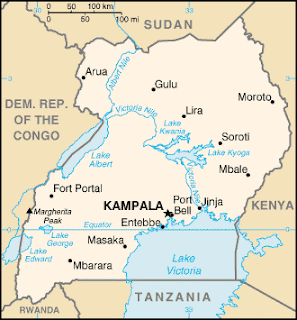
UgandaSeveral months ago, I had the opportunity to speak at a church about our ministry and vision for East Africa. After the service ended, I stayed in the foyer to greet and talk with members.

I’ll never forget what happened next.

A man came up to me and said, “Let me give you some advice. I’ve been going to church for many years and heard a lot of missionary presentations. You were far too negative in what you talked about. Who cares about cults? I want to hear something more positive, about the gospel being shared and Africans coming to know the Lord.”

Now, in all fairness, maybe I wasn’t as balanced as I could have been. And I certainly want to see the conversion of many Africans through the proclamation of the good news of Jesus Christ! Nevertheless, I think that his critique ultimately lacked biblical support. Jesus Himself warns us against those who seek to overthrow our faith in the Sermon on the Mount. So for the next couple of weeks, I want to briefly look at Christ’s words in Matthew 7:15–23.

In these verses, Jesus warns us that we must guard against spiritual deception. Why? As Jesus explains in verses 15–20, deceivers are dangerous:
Beware of false prophets, who come to you in sheep’s clothing but inwardly are ravenous wolves. You will recognize them by their fruits. Are grapes gathered from thornbushes, or figs from thistles? So, every healthy tree bears good fruit, but the diseased tree bears bad fruit. A healthy tree cannot bear bad fruit, nor can a diseased tree bear good fruit. Every tree that does not bear good fruit is cut down and thrown into the fire. Thus you will recognize them by their fruits.
Here we recognize a hidden danger. Jesus begins with the word “beware,” a command. This is not optional, not a suggestion, not a merely good idea. Our Savior requires us to beware of false prophets. And notice that He portrays these false prophets as an active concern, not a rare or occasional challenge. We’re to constantly be on guard against them because they’re always among us.

Wolf in Sheeps ClothingSo who are these false prophets? They claim to speak for God but entrap others through their lies. In the New Testament, we see that they are greedy, arrogant, immoral, and ungodly. But they also impersonate true Christians—they do their work in “sheep’s clothing.” False prophets seldom tell you that they reject the faith; instead, they’re ravenous wolves who actively seek to destroy Christians.

If this is true, how can we recognize them? Jesus provides us with an exposing test: Recognize them by their fruits. Most directly, these fruits are what Jesus has laid out throughout His sermon. Here we find two foundational kinds of fruit—(1) belief in Jesus, and (2) following Jesus’ teaching—in other words, belief and behavior. Both kinds of fruit need to be tested.

To underscore His point, Jesus states the obvious. Grapes can’t come from thornbushes, and figs can’t come from thistles. Plants only produce what is in their nature to produce. Only a healthy tree that bears good fruit; a diseased tree will produce bad fruit. And in this comparison we see that there’s no neutrality. All trees are bearing fruit; the question is, what kind? If you know the fruit, then you can tell the tree. Again, we see Jesus’ seriousness: All of the trees that do not bear good fruit are condemned (“thrown into the fire”). This is the same warning that John the Baptist gives earlier to the Pharisees in 3:7–10.

Finally, in verse 20 Christ repeats Himself: “you will recognize them by their fruits.” All Christians are commanded to be “fruit testers” by the very Lord of Glory.

Which leads me to ask: How seriously do we take spiritual deception? Do we recognize the danger? Are we prepared to test the fruit of those who claim to speak for God, either in what they teach or in how they live?

Let’s not forget that Christ’s command applies to His followers everywhere. How can you and I help our brothers and sisters in Christ around the world to recognize and resist deceivers? False prophets aren’t just a danger only here in America or the West; such people are seeking to overturn the revealed truth of Christ globally.

Next week, we’ll examine Jesus’ second reason for warning us against spiritual deception.

May 15, 2009

Weekly Round-Up

Here's the latest for this week's round-up:

1) Francis Kagolo, "Bishop Oyedepo to preach at Africana" in the New Vision newspaper and Malita Wamala, "Let us make good use of Oyadepo's visit" in the Observer newspaper (Uganda). One of Africa's most well-known and successful prosperity gospel preachers, David Oyedepo, is coming to Uganda for a three-day gospel conference. If you'd like to know more about Oyedepo, his Winners Chapels, or the corrupted health-and-wealth preaching that is spreading throughout Africa, then also be sure to check out

2) Dismus Buregyeya, "Masaka cult approved" in the New Vision newspaper (Uganda). It looks like yet another Catholic cult is growing in Uganda, led by Barnabas Kazibwe. As you can see, the need to research and respond to cults in East Africa is never-ending.

May 13, 2009

Book Review: Theological Pitfalls in Africa

Since African Apologetics has picked up a large number of new visitors and subscribers, for the next few Wednesdays we will be re-running some of John's important book reviews.

Theological Pitfalls in Africa
Byang H. Kato, Theological Pitfalls in Africa (Nairobi, Kenya: Evangel Publishing House, 1975), 200 pp.
At a small Anglican bookshop in Uganda, my eyes stopped when I came across a book on a crowded shelf. Immediately the title struck me--Theological Pitfalls in Africa. Intrigued, I picked up a copy and purchased it. I had never heard of Byang H. Kato (you can read an informative bio here), but I am always interested in learning more about theological controversies where I will be serving my Lord.
Needless to say, I made a wise investment. Kato responds to two dangerous trends he saw emerging in Africa: the growth of universalism and the danger of syncretism within contemporary African theology. Through the continuing influence of ecumenicism and liberal Christian scholarship, Kato writes about the increasing compromise and even abandonment of biblical Christianity throughout the continent.
In this book the author singles out for critique African theologians John Mbiti and Bolaji Idowu, as well as the ecumenical All Africa Conference of Churches (AACC). Through several chapters, he analyzes and replies to numerous problems that have been produced by these Christian leaders. His primary objective is to demonstrate the uniqueness and exclusivity of biblical Christianity against attempts to find parallels and continuity with African Traditional Religions. Additionally, as he records the progress of the ecumenical movement in Africa, he points to the need for an uncompromising evangelical alternative.
I greatly appreciate Kato's wisdom and doctrinal insightfulness throughout this work. He gave me much to think about. However, I do want to mention two cautionary notes. First, I am not sure that Kato is always properly summarizing the views of those whom he disagrees with. Having read some Mbiti, while a lot of Kato's critique is entirely appropriate, I also wonder if Mbiti is always properly understood. Occasionally, I wonder if Kato has set up a straw man only to quickly tear it back down.
Second, this book is rather dated. Of course, its age is not the author's fault! He actually prematurely died not long after this book was published (1975). Nevertheless, I can't help but wonder about the last 30-plus years. How prevalent is the ecumenical movement in Africa today? Where does African liberalism stand compared to the growth of evangelical scholarship? Are there more pressing theological challenges faced by Christians today? Answers to these questions must be found elsewhere.
In spite of these minor concerns, I still heartily recommend Kato's book for anyone looking to learn more about some theological dangers present in Africa today. While I am not sure how easy this book will be to buy outside of Africa, I assure you that it is worth the effort. May we be ever vigilant in our commitment to the Word of God, refuting all attempts to overthrow God's revealed truth!

May 11, 2009

Cross-Cultural Apologetics and Missiology

David HesselgraveIf there’s one area that I believe is almost completely neglected in missiology (the study of missions) today, it’s the role of apologetics. Thankfully, veteran missions scholar David Hesselgrave has clarified its importance in “Revelation and Reason in Cross-Cultural Apologetics and Missiology” in the latest issue of the Journal of the International Society of Christian Apologetics.

Having served as a missionary in Japan for twelve years, Hesselgrave certainly has the experience and insight to address the question: What role do reason and apologetics have in missions? Many answer by saying that reason and apologetics are simply a byproduct of our Western approach to knowledge and are therefore irrelevant to those who have an Eastern or other non-Western way of thinking. But Hesselgrave knows better, and he points us to the trinary approach of conceptual/postulational, concrete-relational/pictorial, and psychical/intuitional ways of thinking rather than the Eastern vs. Western binary approach.

What does this mean? Hesselgrave explains that, instead of there being just two opposite and irreconcilable approaches to knowledge, people in all cultures approach their pursuit of truth in varying combinations of these three ways of thinking. As he summarizes:
“[This] proposal is especially helpful to Western Christian apologists and missionaries because we can anticipate that, as a result of the Imago Dei [i.e., image of God in man], the employment of cogent, coherent and consistent reasoning will be both appropriate and effective in Eastern cultures. At the same time we can anticipate that due to our fallen nature, God-given rationality will be rather easily transmuted into rationalism and irrationalism in both Eastern and Western cultures. Divine revelation will serve both to complement and complete, and to compensate and correct, ways of thinking and knowing in all cultures.”
In other words, reason and apologetics are both needed as we proclaim the gospel to all cultures. But if this is true, what does it mean for cross-cultural missions? Hesselgrave concludes by summarizing four avenues for reappropriating apologetics in our missionary task, namely:
1) Ronald Nash’s tests for truth as rooted in the nature of God,
2) Harold Netland’s defense of our objective propositional faith over fideistic subjectivism,
3) Norman Geisler’s three kinds of essentials of the Christian faith, and
4) Paul Hiebert’s view of the local church as a hermeneutical community.
One need not agree with (or even understand!) all of these applications to approve of Hesselgrave’s conclusion:
“After my experiences in Japan and a half century of subsequent involvement in evangelical missions worldwide I suggest that evangelical apologists and missionaries ‘renew their vows.’ . . . Currently missionary efforts to evangelize the world stand in need of the contributions of evangelical theologians and philosophers. Of course, the converse is also true. Apologists and theologians stand to benefit from the contributions of evangelical anthropologists and cross-culturalists.”
To which I reply with a hearty “Amen!” Hesselgrave’s principles can be used to powerful effect in Africa, and I commend his incisive article to everyone who is committed to our Savior’s missionary task.

May 9, 2009

Weekly Round-Up

Here's the latest for this week's round-up:

1) Paul Fauvet, "Saboteurs Or New Age Fanatics?" on AllAfrica.com and "Mozambique dam was New-Age cleansing ritual - not sabotage" in the Sowetan newspaper (South Africa). In Mozambique, four people belonging to "Orgonise Africa" were arrested as they sought to add "orgon" to the lake. They are a New Age sect which follow the teachings of Austrian psychiatrist Wilhelm Reich.

2) "Expansion for Scientology in South Africa" in Scientology Today. The Church of Scientology recently made a massive purchase in South Africa, the Johannesburg landmark Kyalami Castle. They are continuing to aggressively expand their presence throughout Africa.

3) Latayne C. Scott, "Can't We All Just Get Along?," "Understanding Representational Research," "Agreeing with Spurgeon," "'It's All About the Story'," and "'Can You Un-Cult a Cult?'" on the Koinonia blog. Latayne Scott has been busy, releasing her novel Latter-day Cipher (which I reviewed on this blog) as well as an extensively revised third edition of The Mormon Mirage (which I hope to review soon!). These five posts are on the Zondervan Academic blog, with the series titled "A Former Member Looks at the Mormon Church Today." Be sure to check it out!

May 6, 2009

Responding to a Baha'i

Today, instead of our usual Ask Anything Wednesday, I wanted to briefly interact with someone who commented on my recent blog post Visiting the Bahá’í House of Worship. He wrote the following:


Dear John,
I enjoyed your article and appreciate that you presented the Bahá’í beliefs accurately from your viewpoint. I just want to testify to you that good Christians can and do become Bahá’ís without losing Christ. The early, and modern, Jews were also accused of abandoning the Jewish faith when they embraced Christ. They in fact were embracing the purpose of the Jewish Faith as you know. This example shows how “traditional” views and doctrines may become a barrier to accepting God’s Messiah or Manifestation. One has to return to the Bible itself and understand God’s methods in the past.

Why did the Jews reject Christ? They knew their scriptures, prophecies and promises very well. Their Messiah was expected to “sit on the throne of David,” vanquish the enemies of the Jews, be a descendent of David and bring world peace. The prophet Elijah was also expected to return and prepare the way. By taking these prophecies “literally,” they missed their Messiah. Was John the Baptist the return of Elijah? Jesus said that he was.

The return of Christ in the Person of Bahá’u’lláh can be understood using the same analogy. This alone doesn’t prove that He was Christ returned, but it opens the door to a new way of investigating the Bible concerning this most important subject. I am from a Christian background and am a first generation American Bahá’í. I would be happy to dialogue with you concerning the Biblical evidence that Bahá’u’lláh is genuine.

Harlan


Harlan, I want to thank you for your kind words as well as your interest in discussing the question “Who is Christ?” A more important question cannot be asked!

However, you’ve already shown your guiding authority in interpreting Scripture: Bahá’u’lláh. How do you know that we should see as symbolic the biblical teaching of Christ as God incarnate? How do you know that Christ’s return was fulfilled in Bahá’u’lláh? It’s by first accepting Bahá’u’lláh’s claim to be a true prophet of God. You must read Scripture with him as an already existing authority to understand the Bible in a way that fits with your beliefs. You’ve “stacked the deck,” finding Bahá’u’lláh where you expect and want him to be.

Christians interpret the Bible differently. We seek to understand the Scriptures in their grammatical and historical context to determine the original meaning of the text. This isn’t a question of Jew (OT literal) vs. Christian (OT symbolic/NT literal) vs. Bahá’í (OT and NT symbolic) way of understanding Scripture as you suggest. Rather, it’s a question of how we properly interpret the Bible. In theological terms, it’s the study of hermeneutics. Until you and I can come to an agreement on how we’re supposed to interpret the Bible, a discussion of specific texts would yield little fruit.

It’s exactly at this point that you’re merely making an assertion about interpreting Scripture symbolically because of your commitment to Bahá’u’lláh. I ask you to come to the Bible asking what God has revealed through what the writers of Scripture themselves intended to say. If you do so, then you will open yourself to God’s truth that directs us to the God-man, Jesus Christ, and His redeeming work.

Good Christians cannot and will not become Bahá’ís without losing Christ. Christ cannot be demoted to the level of human prophets. He is the prophet, as well as priest and king. All other true prophets direct us to Him. Bahá’u’lláh was a false prophet. I pray that you will recognize this fact and believe in the One who reconciles us with our Creator.

May 4, 2009

Advancing African Apologetics in Charlotte

TEAMBy God’s grace, for the last several months our ministry has been developing an important relationship with the Tactical Evangelism and Apologetics Mission (TEAM) at Southern Evangelical Seminary (SES), an evangelical school founded by world-renowned apologist Norman Geisler. Last weekend, Paul Carden (the Executive Director of our parent ministry) and I finally had the opportunity to travel to Charlotte, North Carolina and personally meet with TEAM’s leadership. Many of you were praying for these strategic meetings, and I can hardly believe how much the Lord allowed us to accomplish in such a brief time together.

First, we met with a number of African seminary students at SES. I was so encouraged to talk with those who came all the way from Kenya, Congo, Liberia, and South Africa to study apologetics! Their passion for defending our common faith was both edifying and challenging. All of them wanted to bring biblical discernment and the defense of the faith to Africa. May the Lord bless their cause and increase their number!

Second, we met with several missionaries who are actively engaged in various ministries within Uganda. They also have a heart for protecting Christians in East Africa and reaching out to those trapped in error with the true hope of Jesus Christ. We discussed how we could work together, building on each other’s strengths to serve the church in Uganda and beyond.

Paul Simon and NelThird, we spent extensive time with Simon Brace, the director of TEAM, and his wife Nel. Simon is a gracious and humble man who’s aflame for the defense of the Gospel worldwide. I instantly knew that we were kindred spirits (including our great appreciation for Ravi Zacharias and Indiana Jones). I’m confident that we’ll accomplish great things for Christ as we continue building our relationship and working with Simon and TEAM.

Fourth, I was given the opportunity to preach and present our ministry’s vision at Community Fellowship Church. The church’s interest and enthusiasm for our future was remarkable—the congregation nearly cleaned us out of ministry brochures, DVDs, and bookmarks! They’re clearly committed to upholding the truth of God’s Word and exposing error both locally and globally. Worshiping with them was truly a time of joy.

Nevertheless, all good things must come to an end (as they say), and I headed home late Sunday evening. How the Lord blessed our time in Charlotte! Strategic partnerships were developed, new friendships were made, and Christ was glorified. May we continue to faithfully serve Him as we defend His truth in East Africa!